





Journal
Chin Lift in Korea 2026: Rowena's Real Journey and the Complete Chin Lift Guide
2026-02-27
Facial Contouring
Chin Lift in Korea 2026: Rowena's Real Journey and the Complete Chin Lift Guide
Summary
- Medical: A chin lift, known medically as a neck lift or lower rhytidectomy, tightens the muscles and skin under the chin, removes double chin fat, and restores a clean jawline, and in Korea the procedure typically runs roughly 40 to 60 percent below all-in US pricing.
- Technology: This guide settles the chin lift vs neck lift question once and for all, and walks through the techniques Korean surgeons combine in a single session, including submental liposuction, platysmaplasty, and cervicoplasty.
- Care: Docfinderkorea's Full-Care Agency model (Direct Surgery Monitoring, In-Person Hospital Accompaniment, All-Inclusive Recovery Care) plus a 24/7 Premium Concierge carried Rowena, a 50-year-old from Sydney, from her first video call to her surgery day at ID Clinic in Seoul.
Quick Facts: Chin Lift in Korea (2026)
- Surgery duration: about 1 to 3 hours, depending on how much muscle tightening and fat removal is planned.
- Anesthesia: general anesthesia is typical; local anesthesia with sedation is possible for liposuction-only cases.
- Incisions: a small, well-hidden incision under the chin (submental), sometimes with discreet incisions around the ears for fuller lifts.
- Compression garment: a chin strap worn full time for about 3 to 7 days, then at night for a few weeks.
- Back to work: most patients return to desk work in 7 to 14 days.
- Exercise: light cardio at 2 to 3 weeks; full workouts once your surgeon clears you.
- Final result: the jawline sharpens over 3 to 6 months and is essentially permanent with a stable weight.
- Recommended stay in Korea: 10 to 14 days for stitch removal and deswelling care before you fly home.
Table of Contents
- What Is a Chin Lift? (And Why Doctors Call It a Neck Lift)
- Why Patients Choose a Chin Lift in Korea (2026)
- Chin Lift Techniques: Korea's Medical Edge in 2026
- Chin Lift vs Neck Lift: What Is the Real Difference?
- Rowena's Story: From Sydney to Seoul for a Fresh Start at 50
- Why Rowena Chose a Full-Care Agency, Not an App
- How to Book a Chin Lift in Korea: Step-by-Step
- Chin Lift Cost in Korea vs the United States (2026)
- Chin Lift Recovery Time: Week by Week
- The Seoul Recovery Lifestyle
- FAQ: Chin Lift in Korea
- Your Next Step
- Related Articles
What Is a Chin Lift? (And Why Doctors Call It a Neck Lift)
If you have been searching for a chin lift, here is the first thing worth knowing: in most plastic surgery clinics, a chin lift and a neck lift are the same operation. Major medical institutions such as the Cleveland Clinic literally write it as "neck lift surgery (chin lift)," and surgeons may also call it a lower rhytidectomy. Whatever the label, the goal is identical: to lift and tighten the soft tissue between your chin and your neck so the jawline reads as one clean, youthful line again.
A chin lift addresses the changes that creams and facial exercises simply cannot reach. It softens jowls along the jaw, removes the pocket of submental fullness most of us call a double chin, tightens sagging neck skin, and corrects the vertical platysma bands, sometimes nicknamed the "turkey wattle," that appear when the neck muscle loosens with age. Because the double chin is such a common trigger, many people also arrive at this procedure by searching for double chin surgery or submental liposuction, and both of those fall under the same chin lift umbrella.
You are in good company if this area bothers you. Research published by the American Society for Dermatologic Surgery found that up to 68 percent of Americans are bothered by fullness under the chin. The encouraging news is that this is one of the most fixable concerns in all of facial plastic surgery, and 2026 is arguably the best moment yet to fix it, especially in Seoul.
Why Patients Choose a Chin Lift in Korea (2026)
South Korea performs more facial procedures per capita than any other country, and Seoul's Gangnam district concentrates hundreds of clinics whose surgeons operate on jawlines and necks every single day. That repetition matters. A chin lift is a precision procedure performed around nerves that control your smile, and the specialist density in Korea means international patients can access surgeons for whom this operation is routine rather than occasional.
It helps to be clear about what a chin lift is and is not. It is a soft tissue procedure: it repositions muscle, removes fat, and trims excess skin. It is not a chin implant (mentoplasty), which changes the bony projection of the chin itself, and it is not a weight loss procedure. The best results come from matching the right technique to your anatomy, which is exactly where Korean consultation culture, with its detailed imaging and frank technique discussions, shines.
Who is an ideal candidate?
- You have a double chin, jowls, or loose neck skin that persists no matter your weight or skincare routine.
- You see vertical neck bands when you tense your jaw or look down at your phone.
- You are generally healthy, a non-smoker or willing to pause smoking, and have realistic expectations.
- You want a defined jawline without changing the fundamental character of your face.
This is the situation Rowena, a 50-year-old from Sydney, Australia, found herself in before she flew to Seoul for a full facelift with an explicit chin-incision neck lift at ID Clinic. Her journey was documented by Docfinderkorea on YouTube:
We will follow her story throughout this guide, because it shows exactly how the chin lift decision unfolds in real life.
Chin Lift Techniques: Korea's Medical Edge in 2026
A modern chin lift is not one fixed operation but a toolkit. During your consultation, a Korean surgeon will typically combine two or three of the following techniques into a single surgical plan.
Submental Liposuction (Chin Lipo)
Through an incision of just a few millimeters under the chin, the surgeon removes the fat pocket that creates a double chin. In younger patients with elastic skin, submental liposuction, sometimes called submental lipectomy, can be the entire procedure, performed under local anesthesia with sedation in under an hour.
Platysmaplasty: The Internal Corset
The platysma is the thin sheet of muscle that covers the front of your neck. With age it loosens and splits in the midline, creating visible bands. In a platysmaplasty, the surgeon sutures the edges of the muscle back together under the chin, tightening it like an internal corset. This is the muscle-tightening step that gives a chin lift its long-lasting structural power, and it is precisely what Rowena's surgeon planned through a small incision under her chin.
Cervicoplasty: Removing Excess Skin
When skin has stretched beyond its ability to snap back, the surgeon trims and redrapes it, usually through incisions tucked behind the ears. Cervicoplasty is what makes the difference for patients with genuinely loose, hanging neck skin rather than just fat.
The Anterior Neck Lift
A signature of contemporary practice, the anterior neck lift works entirely through the chin incision. The surgeon can sculpt not only the fat above the muscle but also the deeper subplatysmal fat beneath it, then tighten the muscle, all without touching the ears. For patients whose concern is concentrated under the chin, this approach delivers a dramatic profile change with minimal visible evidence.
The Extended Neck Lift with a Facelift
When jowls and mid-face sagging accompany the neck, surgeons often pair the chin lift with a facelift, most commonly an SMAS lift, so the face and neck rise together as one harmonious unit. This is the combination Rowena chose, and it is why her surgeons discussed lifting "the lower part of my face" and tightening "the neck muscles to go with the face up as well," as she put it.
Safety in Korean Operating Rooms
Korea has built one of the most transparent surgical safety cultures in the world. Operating rooms in major clinics are equipped with CCTV, a legal measure that eliminated so-called ghost surgery, so the surgeon you meet is the surgeon who operates. Leading clinics keep a full-time anesthesiologist on staff for every general anesthesia case, and Docfinderkorea partners only with hospitals registered with the Korea Health Industry Development Institute (KHIDI) whose surgeons hold board certification from the Korean Society of Plastic and Reconstructive Surgeons (KSPRS). International patients routinely tell us the system feels more closely supervised than what they expected at home, and that confidence is exactly the point.
Chin Lift vs Neck Lift: What Is the Real Difference?
Let us settle the chin lift vs neck lift question directly, because it is the single most common point of confusion. In everyday clinical usage there is no difference: a chin lift is a neck lift, formally a lower rhytidectomy. The terms describe the same family of procedures viewed from different angles. Patients bothered by the area directly under the chin tend to say chin lift; patients bothered by loose skin lower down tend to say neck lift; surgeons treat it all as one aesthetic unit.
The distinctions that actually matter are between procedures, not names. A chin lift lifts and tightens soft tissue, while a chin implant (mentoplasty) adds projection to a recessed chin bone, a completely different operation that is occasionally combined with a lift. Likewise, standalone chin liposuction removes fat but tightens nothing, which is why it suits younger necks, whereas a full chin lift adds muscle repair and skin removal for more advanced aging. If you remember one thing from the chin lift vs neck lift debate, make it this: choose the technique based on what your tissue needs, not on which keyword you happened to search.
Rowena's Story: From Sydney to Seoul for a Fresh Start at 50
Rowena's journey is documented in Docfinderkorea's video and it begins with something far more relatable than vanity: how other people read her face.

"Generally a lot of people just think I look sad all the time and I'm just no emotion and they just think 'Are you OK?' and I'm like 'yeah', so I think more of a just a general feeling that I don't look sad to everyone would be nice," she explains at the start of the video. It is the classic story of the lower face: as the jawline and neck soften, the resting expression drifts toward tired and downcast, no matter how you actually feel.
What makes Rowena's case such a useful guide for chin lift researchers is how she thought about scope. "I think you just get to a point where it's one thing and then it's another thing and then it's just this combination of everything all together and you just think... I need to get this all fixed all at once, cause no point just doing one part and ignoring something else." Her surgical plan at ID Clinic in Seoul reflected that: a sub brow lift, under-eye fat grafting, a full SMAS facelift, and AccuLift laser fat reduction, anchored by a chin-incision neck lift with muscle tightening under the chin and removal of submental fat.
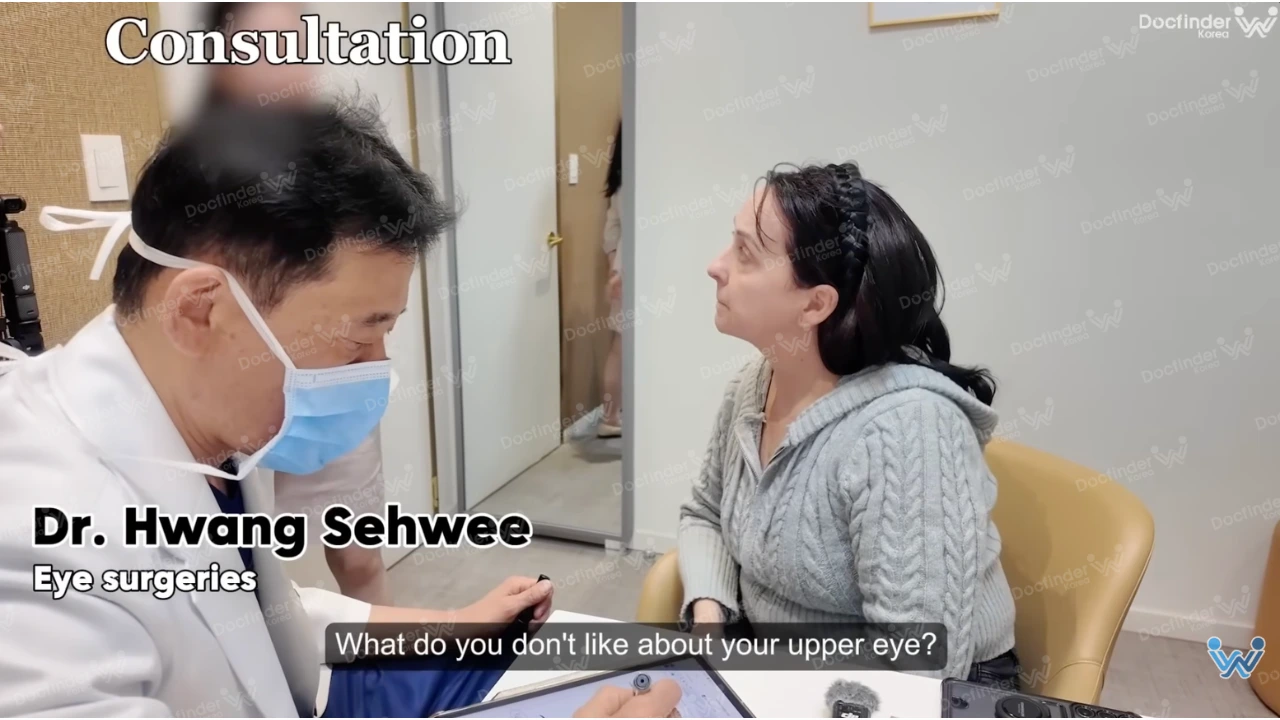
The consultation scene in the video captures the chin lift conversation almost verbatim. Her surgeon told her, "We're gonna remove that fat over there and we're gonna tie the muscle under your chin." Rowena checked her understanding: "We're gonna do a little incision under your chin to tie up the muscle for the neck?" The answer: "Yeah... a small incision." In two sentences, that exchange is the entire anatomy of a modern chin lift: submental fat removal plus platysma tightening through a hidden incision.
She also described how the second surgeon she consulted mapped the plan: "The second surgeon was talking about we'll do a little incision here and a little incisions around here or down around here, and that'll be lifting the lower part of my face, and under there just to tighten the neck muscles to go with the face up as well." Notice what happened there: she arrived thinking about a facelift, and the consultation naturally folded the neck and chin into the plan, because Korean surgeons treat the jawline as one continuous line.
Cost was the factor that had kept her waiting for years. "I probably didn't think about doing a whole anti-aging surgery in itself because I thought in Australia it was so expensive, but I think the opportunity to do it in Korea was in the back of my mind, and I thought if I'm ever going to do it I think it would be in Korea." Once the numbers made sense, the decision came fast. "I was like wow, a bit excited and then I was like 'okay let's do it', let's do it, commit, let's do it! So yeah, I was all in straight away."
Her expectations, refreshingly, stayed grounded. "I think it's an Age Reset but it's not reset to zero... I think it's just gonna be the age reset to how I feel, not to what I look like," she says, adding, "I'm not expecting it to change my life but I am expecting to help me just get on with my life with less worries about maybe how people see me — people always think I'm sad, hopefully they won't see that anymore."
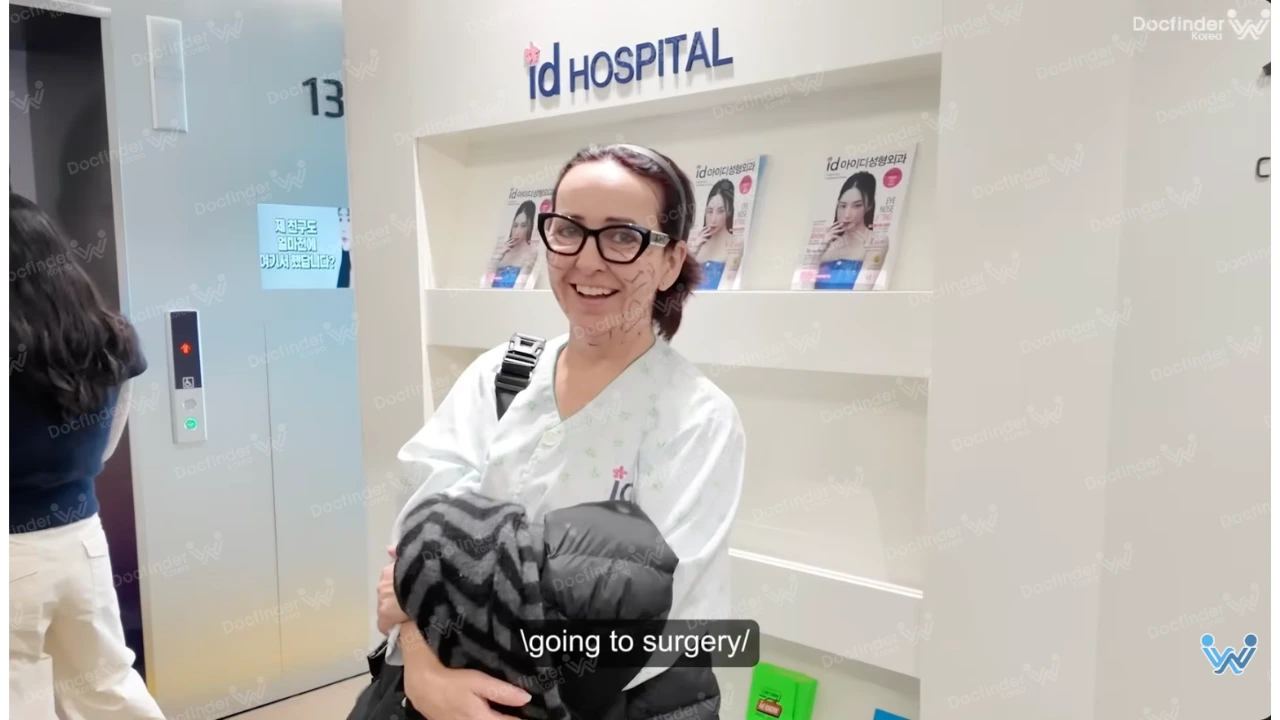
Part 1 of her story ends on the morning that matters most. "Hi, it's a surgery day today and we're here at ID Clinic already and getting excited, probably nervous and excited, didn't sleep that well last night but that's okay, that's to be expected, but I'm all prepared." That mix of nerves and readiness is what a well-prepared surgery day actually feels like, and everything that got her to that calm, organized moment is the subject of the next section.
Why Rowena Chose a Full-Care Agency, Not an App
Booking apps such as Gangnam Unni or Babitalk work fine for domestic patients who speak Korean, live nearby, and can handle their own follow-ups. For an international patient flying eleven hours from Sydney for a chin lift and facelift combination, book-and-go is not a plan. Rowena traveled with Docfinderkorea, a Ministry of Health and Welfare registered Full-Care Agency, and structured her whole trip around recovery: "I was planning to come to Korea for about a month's stay because I visited before and I just wanted to be here for a little bit longer."
The Full-Care model rests on three pillars. Direct Surgery Monitoring means a coordinator is present at the clinic on surgery day, tracking your operation from check-in to recovery room. In-Person Hospital Accompaniment means you never sit in a consultation or follow-up without a fluent medical translator beside you, which is how Rowena could interrogate her surgical plan down to the location of each incision. All-Inclusive Recovery Care covers the unglamorous logistics that make or break a trip: medication pickups, deswelling appointments, transport, and a 24/7 Premium Concierge chat line for the 3 a.m. questions.
What does this cost the patient? Nothing. Docfinderkorea is paid by its partner clinics, so patients pay the same official prices as walk-in locals, with no extra cost and no markups. The agency's incentive is aligned with yours: it only works if your surgery and recovery go well, which is why it acts as your advocate rather than a salesperson for any single clinic.
How to Book a Chin Lift in Korea: Step-by-Step
- Free online consultation: send photos of your chin and neck through the quick inquiry form, and receive technique recommendations and quotes from matched clinics, usually within days.
- Plan the trip: pick dates, and let the concierge team arrange accommodation near the clinic; 10 to 14 days in Korea is ideal for a chin lift.
- Airport pickup: a coordinator meets you at Incheon and takes you to your hotel, so the journey ends the moment you land.
- In-person consultation: meet your surgeon with a translator present, review imaging, and finalize the technique mix, whether that is liposuction alone or a full lift with platysmaplasty.
- Surgery day with Direct Surgery Monitoring: check in, meet the anesthesiologist, and let your coordinator manage everything else, just as Rowena did at ID Clinic.
- First week: rest with your chin strap on, attend deswelling treatments, and have stitches removed around day 5 to 7.
- Fly home with follow-up: after your final check, you depart with aftercare instructions and a concierge line that stays open for remote follow-up.
Chin Lift Cost in Korea vs the United States (2026)
Now to the question behind most searches: chin lift cost. In the United States, the American Society of Plastic Surgeons lists the average surgeon's fee for a neck lift at 7,885 US dollars, and that figure covers the surgeon's fee only. Once anesthesia, operating facility, and aftercare are added, patient-reported all-in totals commonly land between 10,000 and 15,000 dollars, and premium markets run higher. Standalone chin liposuction in the US typically costs around 4,000 dollars, with quotes ranging from roughly 2,000 to 5,000 dollars. Because a chin lift is cosmetic, insurance does not cover it in either country.
Korea changes the math substantially. As guidance ranges for international patients in 2026, a standalone chin lift or neck lift in Seoul, including platysmaplasty and submental fat removal, generally runs between 5,000,000 and 10,000,000 Korean won, which is roughly 3,200 to 6,500 US dollars at the current exchange rate of about 1,540 won per dollar. Submental liposuction on its own is commonly quoted between 2,000,000 and 4,000,000 won, or about 1,300 to 2,600 dollars. Patients combining the chin lift with a full facelift, as Rowena did, can expect combined packages in the range of 10,000,000 to 22,000,000 won (roughly 6,500 to 14,300 dollars) depending on whether an SMAS or deep plane technique is used, with the neck component typically adding the equivalent of 2,000 to 3,000 dollars to a facelift quote.
Two practical notes make the comparison even more favorable. Korean quotes are usually genuinely all-inclusive, covering anesthesia by a dedicated anesthesiologist, facility fees, medications, the compression garment, and deswelling care, which are precisely the line items that inflate US bills. And international patients can claim a 10 percent VAT refund on cosmetic procedures when leaving Korea. Even after flights and a comfortable two-week stay, most patients find the chin lift cost in Korea lands 40 to 60 percent below a comparable all-in US total. Treat every figure above as a guidance range: your exact quote depends on your anatomy and technique mix, which is why the free consultation exists.
Chin Lift Recovery Time: Week by Week
The second question every patient asks is about chin lift recovery time, and the honest answer is: shorter than most people fear, as long as you respect the first two weeks. Here is the realistic timeline.
Days 1 to 3: Rest and Compression
You will wake up with a snug chin strap supporting your new contour, and you will wear it around the clock for the first 3 to 7 days. Swelling and tightness peak in this window and feel more strange than painful; most patients manage with ordinary prescribed medication. Follow the classic aftercare rules: keep your head elevated above your heart even while sleeping, avoid twisting or bending your neck, and never place ice directly on the skin of your neck, since sensation is temporarily reduced. In Korea, this is the phase where your coordinator delivers medications and checks on you daily.
Days 4 to 7: Stitches Out, Swelling Down
Bruising begins to fade and stitches under the chin typically come out around day 5 to 7. Many clinics start deswelling treatments now, and gentle walks are encouraged. The chin strap usually transitions to nights only.
Weeks 2 to 3: Back to Life
Swelling and bruising largely settle between days 10 and 14, and most patients return to desk work somewhere in the 7 to 14 day window, often camera-ready with light concealer. Light exercise resumes at 2 to 3 weeks. This is also when international patients are typically cleared to fly, which is exactly why Rowena built a generous stay into her plan rather than rushing home; her month in Korea meant her entire early chin lift recovery time was spent within reach of her surgical team and concierge.
Months 1 to 6: The Reveal
The jawline continues to refine as residual swelling resolves and the tissue settles into its lifted position. By month 3 you will see the shape clearly, and by month 6 the final result is in. From there, results are essentially permanent: the removed fat does not return with a stable weight, and the tightened muscle keeps its corset effect for many years.
The Seoul Recovery Lifestyle
Recovering in Seoul is a genuine part of the appeal. Korean recovery culture is built around deswelling: clinics offer light therapy and lymphatic massage sessions, convenience stores stock hobakjeup, the pumpkin juice Koreans swear by for reducing post-surgical puffiness, and pharmacies are everywhere and efficient. Gangnam's flat, walkable blocks are ideal for the gentle daily strolls your surgeon will prescribe, and quiet cafes make the strap-at-night phase feel less like convalescence and more like a slow holiday. Your concierge handles the logistics, from appointment transport to restaurant recommendations soft enough for a healing jawline, so your only real job is to heal.
FAQ: Chin Lift in Korea
Am I a good candidate for a chin lift?
If a double chin, jowls, neck bands, or loose skin under the chin bothers you and your weight is stable, you are likely a candidate for some version of the procedure. The technique mix, from liposuction alone to a full lift, is decided at consultation based on your skin elasticity and anatomy.
Is chin liposuction enough, or do I need the full chin lift?
Chin liposuction alone works beautifully when the problem is fat and the skin is still elastic, which usually means younger patients. If muscle bands or loose skin are part of the picture, liposuction alone can actually make laxity more visible, so a chin lift with platysmaplasty and skin tightening is the better investment.
How much does a chin lift cost, and does insurance cover it?
In Korea, guidance ranges run from about 1,300 to 2,600 US dollars for submental liposuction alone to roughly 3,200 to 6,500 dollars for a full chin lift, versus common all-in US totals of 10,000 dollars and up. Insurance does not cover cosmetic chin lifts in any country, which makes Korea's pricing advantage all the more meaningful.
How long is chin lift recovery time?
Plan on 7 to 14 days before returning to work, 2 to 3 weeks before exercise, and 3 to 6 months for the final refined result. Most international patients stay in Korea for 10 to 14 days so stitch removal and early deswelling happen under their surgeon's eye.
What anesthesia is used?
A full chin lift is usually performed under general anesthesia with a full-time anesthesiologist present throughout, while liposuction-only procedures can often be done under local anesthesia with sedation. Your medical history is reviewed in advance during the online consultation.
Will I have visible scars?
The main incision hides in the natural crease under your chin and typically fades to a faint line that is invisible in conversation. When ear incisions are needed for skin removal, they follow the natural folds around the ear, the same well-hidden approach used in facelifts.
How long do chin lift results last?
Effectively, they are permanent. Fat removed by liposuction does not grow back with a stable weight, and the tightened platysma holds for many years. You will keep aging from the day of surgery, but from a dramatically better starting point.
Is it safe to travel to Korea alone for surgery?
Yes, and Rowena is the proof: she flew solo from Sydney at 50 and arrived at ID Clinic on surgery morning feeling "nervous and excited... but I'm all prepared." With a Full-Care Agency providing airport pickup, translation, Direct Surgery Monitoring, and 24/7 concierge support, solo patients are never actually alone at any step that matters.
Your Next Step
If your mirror or your phone camera has been telling you it is time, start the way Rowena did: with a free, no-obligation online consultation at https://docfinderkorea.com/quick-inquiry. Send a few photos, describe what bothers you, and Docfinderkorea's government-certified, Ministry of Health and Welfare registered team will match you with board-certified chin lift specialists in Seoul, complete with quotes, technique recommendations, and a 24/7 Premium Concierge from the moment you land. The service costs you nothing; the clinics pay the agency. Your jawline has waited long enough.
Related Articles
Plastic Surgery Face Lift in Korea: The 2026 Ultimate Guide
Neck Wrinkle Treatment in Korea 2026: The Definitive Guide to Reclaiming Your Youthful Profile
Ultimate Guide to Deep Plane Facelift Surgery in Korea (2026)
What is Facial Liposuction and Why is it Popular in Korea?
Back