





Journal
Neck Wrinkle Treatment in Korea 2026: The Definitive Guide to Reclaiming Your Youthful Profile
2026-04-01
Facial Contouring, Anti-aging
Neck Wrinkle Treatment in Korea 2026: Maria's Real Face and Neck Lift Journey and the Complete Patient Guide
Summary
- Medical: Neck wrinkle treatment in Korea spans a fifteen-minute injectable session to a full platysmaplasty neck lift, at 40 to 65 percent below comparable United States surgery.
- Technology: Korean clinics run the widest menu of non-surgical neck wrinkle treatment in the world, pairing micro-focused ultrasound and radiofrequency with regenerative injectables that thicken thin neck skin rather than only tightening it.
- Care: Maria flew to Seoul with her daughter for an anti-aging plan built around an incision face and neck lift, supported by Docfinderkorea's Direct Surgery Monitoring, In-Person Hospital Accompaniment, All-Inclusive Recovery Care and 24/7 Premium Concierge, at no extra cost.
Quick Facts: Neck Wrinkle Treatment in Korea (2026)
- Treatment span: injectables and energy devices for early lines, surgery for loose skin and platysmal bands.
- Surgical duration: two to three hours for a neck lift with platysmaplasty, under general anesthesia.
- Incisions: hidden under the chin and behind the ears, tucked into the hairline.
- Stitch removal: day 7 to day 10, with a compression band through the first week.
- Time to result: two to four months for devices, three to six months for the final surgical contour.
- Recommended stay in Korea: 5 to 7 days non-surgical, 10 to 14 days for surgery.
- Guidance price in Seoul: about 105 to 1,750 USD non-surgical, 3,500 to 7,500 USD for a surgical neck lift.
Table of Contents
- Why Patients Choose Neck Wrinkle Treatment in Korea in 2026
- Neck Wrinkle Treatment in Korea: The Medical Edge
- Non-Surgical Neck Wrinkle Treatment: What Works Without an Incision
- How to Get Rid of Neck Wrinkles: Matching the Treatment to the Line
- Maria's Story: A Mother, a Daughter, and Eight Procedures in Seoul
- Why Maria Chose a Full-Care Agency, Not an App
- How to Book Neck Wrinkle Treatment in Korea: Step by Step
- Neck Wrinkle Treatment Cost in Korea 2026: What You Actually Pay
- Neck Lift Recovery Timeline: Week by Week
- The Seoul Recovery Lifestyle
- Frequently Asked Questions About Neck Wrinkle Treatment
- Your Next Step
- Related Articles
Why Patients Choose Neck Wrinkle Treatment in Korea in 2026
You can spend years perfecting the skin on your face and still be given away by the six inches below it. The neck is where age arrives first and hides worst, and it is why a good result reads as rested rather than younger. When the jaw and the neck form one clean line, everything above them reads better too.
That is why neck wrinkle treatment has become one of the fastest-growing requests among international patients arriving in Seoul. South Korea welcomed 1.17 million foreign patients in 2024, nearly double the previous year, with dermatology accounting for 56.6 percent of those visits and plastic surgery second at 11.4 percent. Nowhere else concentrates that much lifting and tightening experience into a few square kilometres of one city.
What Neck Wrinkle Treatment Can and Cannot Do
Neck wrinkle treatment is a contouring and skin-quality project, not a weight-loss one. It can soften horizontal necklace lines, relax the vertical platysmal bands that stand out when you speak, tighten crepey texture, remove the fat pad under the chin and redrape skin that no longer springs back. It cannot substitute for weight change, and no single device erases a decades-old crease in one session.
Who Is an Ideal Candidate for Neck Wrinkle Treatment
- Horizontal necklace lines or crepey texture that creams no longer disguise.
- Vertical cords appear down the front of your neck when you talk or tense.
- Fullness under the chin blurs the line between your jaw and your neck.
- Your face still looks well but photographs from below age you by a decade.
- You are in reasonable health, you do not smoke, and you can give Korea one to two weeks.
Watch Maria's full journey:
Neck Wrinkle Treatment in Korea: The Medical Edge
The neck ages differently from the face, and the best neck wrinkle treatment plans are built around that difference rather than borrowed from facial protocols.
Why Neck Skin Gives You Away First
Neck skin is thinner than facial skin and carries fewer oil glands and hair follicles, so it holds less moisture and shows sun damage sooner. It also sits over the platysma, a broad sheet of muscle running from the collarbone to the jaw. As that sheet loosens its front edges separate and stand forward as two visible cords. Add gravity pulling on collagen-depleted skin and you get slack skin, standing bands and a blunted jawline.
The Tech Neck Generation
A newer group of patients arrives in their late twenties and thirties with lines that used to appear two decades later, and the reason sits in their hands. Neurosurgeons measuring forward head posture found that a fifteen-degree head tilt puts roughly 27 pounds of force through the cervical spine and sixty degrees about 60 pounds, which the European Spine Journal has called a silent pandemic. Skin folded downward for hours a day eventually keeps the fold.
What Korean Surgeons Do Differently
Korean lift surgery is built on layered work rather than skin pulling. A modern neck lift addresses three planes in one sitting: submental liposuction removes the fat pad under the chin, platysmaplasty stitches the separated muscle edges into a firm sling, and only then is the skin redraped and trimmed. Because the tension sits in the muscle rather than the skin, the result holds longer and the hidden incisions close without stretched, shiny scars.
Safety You Can Actually Verify
Docfinderkorea works only with hospitals registered with the Ministry of Health and Welfare and KHIDI, staffed by surgeons board certified through the Korean Society of Plastic and Reconstructive Surgeons. Operating rooms carry CCTV, so the surgeon you consulted is the surgeon who operates, and a full-time anesthesiologist monitors your vitals throughout. You know the hospital, the surgeon and the technique before you board a plane.
Non-Surgical Neck Wrinkle Treatment: What Works Without an Incision
Most people arrive hoping the answer is non-surgical, and for a large share of them it is. Non-surgical neck wrinkle treatment in Seoul is unusually strong because clinics run several device platforms side by side and combine them in one visit rather than selling a single machine.
Energy-Based Lifting
Micro-focused ultrasound, best known as Ultherapy, sends heat to a fixed depth in the SMAS and platysma layer, triggering a contraction now and new collagen over the following months, and it is the workhorse for mild laxity along the jawline and upper neck. Radiofrequency devices such as Thermage FLX work in a shallower field and suit crepey texture and fine horizontal lines. Many Korean clinics stack the two in a single afternoon.
Regenerative Injectables
This is where Korea genuinely leads. Rejuran, derived from salmon DNA fragments, is injected in a fine grid across the neck to rebuild dermal thickness rather than to fill. Juvelook and similar PDLLA hybrids stimulate your own collagen over three to six months, and hyaluronic acid skin boosters restore the moisture neck skin loses first. None of these lift, but they change the material you are lifting.
Neck Botox and the Nefertiti Lift
Small, widely spaced doses of botulinum toxin along the platysmal bands relax the cords that pull the jawline down. Done well, the Nefertiti lift sharpens the mandibular border without freezing expression. Results appear within a week and last three to four months, which makes it the most common entry point into non-surgical neck wrinkle treatment and a useful test of how much of your concern is muscle rather than skin.
How to Get Rid of Neck Wrinkles: Matching the Treatment to the Line
The most common mistake is choosing a treatment before naming the problem. If you are asking how to get rid of neck wrinkles, work out which of four things you are looking at, because each answers to a different tool.
- Horizontal necklace lines are creased skin: regenerative injectables, fractional laser and radiofrequency; the deepest soften rather than disappear.
- Vertical platysmal bands are muscle: botulinum toxin early, platysmaplasty once the cords stand permanently.
- Crepey, papery texture is thin skin: skin boosters, Rejuran, microneedling and daily sunscreen.
- Loose skin and a blunted jawline are structure: submental liposuction and a surgical neck lift.
Prevention still matters, and Korean dermatologists say it first. Up to eighty percent of visible skin aging is attributed to unprotected sun exposure, and the neck is the area people most reliably forget. Broad-spectrum SPF 30 carried past the collarbone, a retinoid at lower strength than you would use on the face, and a screen raised to eye level do more over ten years than any single session. The realistic answer to how to get rid of neck wrinkles is a sequence: protect the skin, rebuild its thickness, relax the muscle, then tighten the structure if structure is what is loose.
Maria's Story: A Mother, a Daughter, and Eight Procedures in Seoul
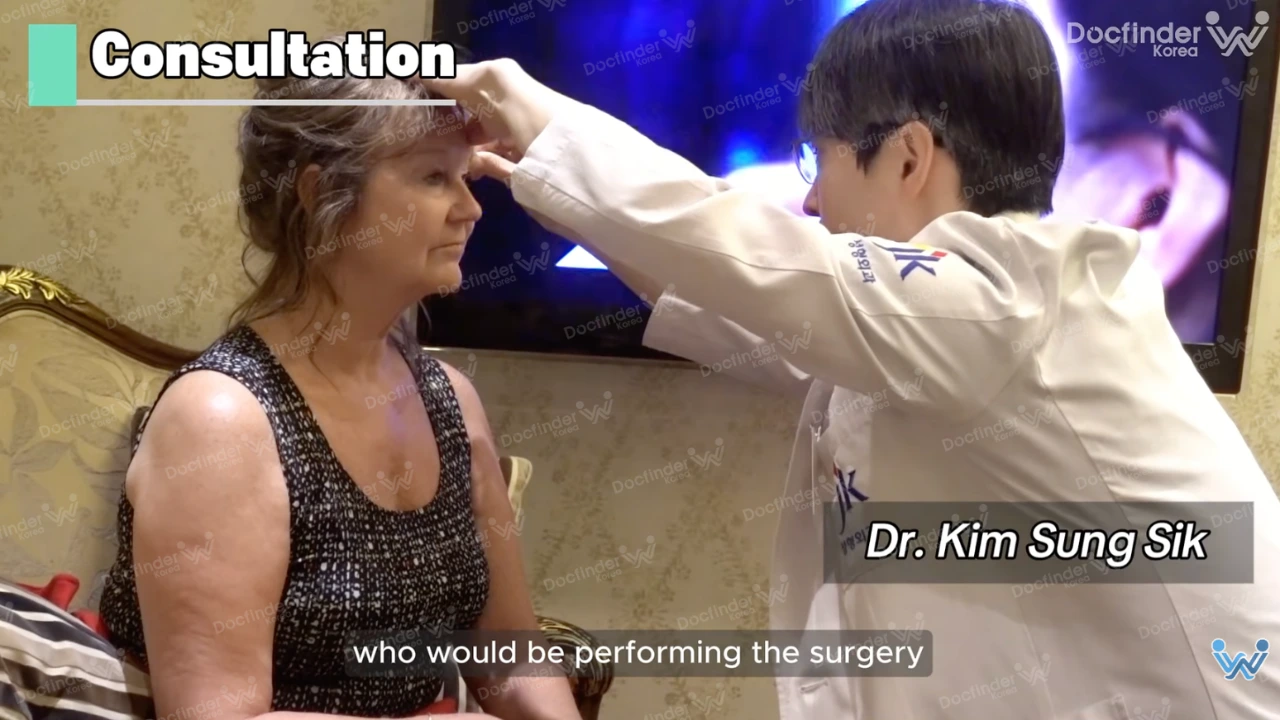
Maria did not come to Seoul for a single line. She came for the whole picture, and she came with her daughter.
Like a lot of women who reach the point of booking, she had watched the change happen slowly and in a specific order. The face was still recognisably hers; what had shifted was the frame around it, with heaviness through the brow, softness under the eyes and a lower face and neck that had stopped holding a clean edge. Creams and clever camera angles were doing the work skin used to do on its own.
What she said on the way in was not about wrinkles at all. Speaking before surgery, she put it simply: I'm so excited. It just came at such a great time in my life, and I get to be here with my daughter. That is the part patients rarely plan for and always remember. Her daughter travelled with her, sat through the consultations, and was there in the recovery room, and the trip became something the two of them did together rather than something Maria did quietly and alone.
What Maria Actually Had Done
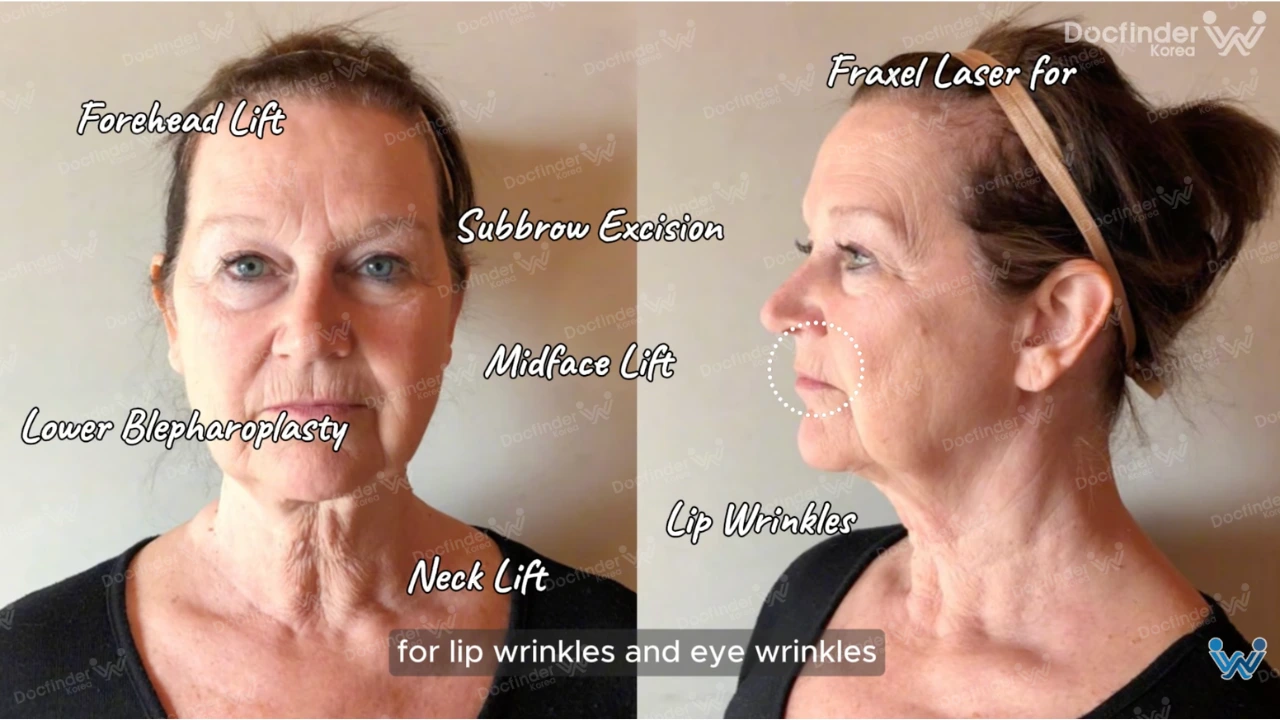
Her plan was built as one coordinated anti-aging programme rather than a list of separate visits, and it ran to eight procedures: a forehead lift, an incision face and neck lift, chin liposuction, lower blepharoplasty with a cheek lift, a sub-brow excision, Fraxel laser resurfacing for wrinkles, and mole removal.
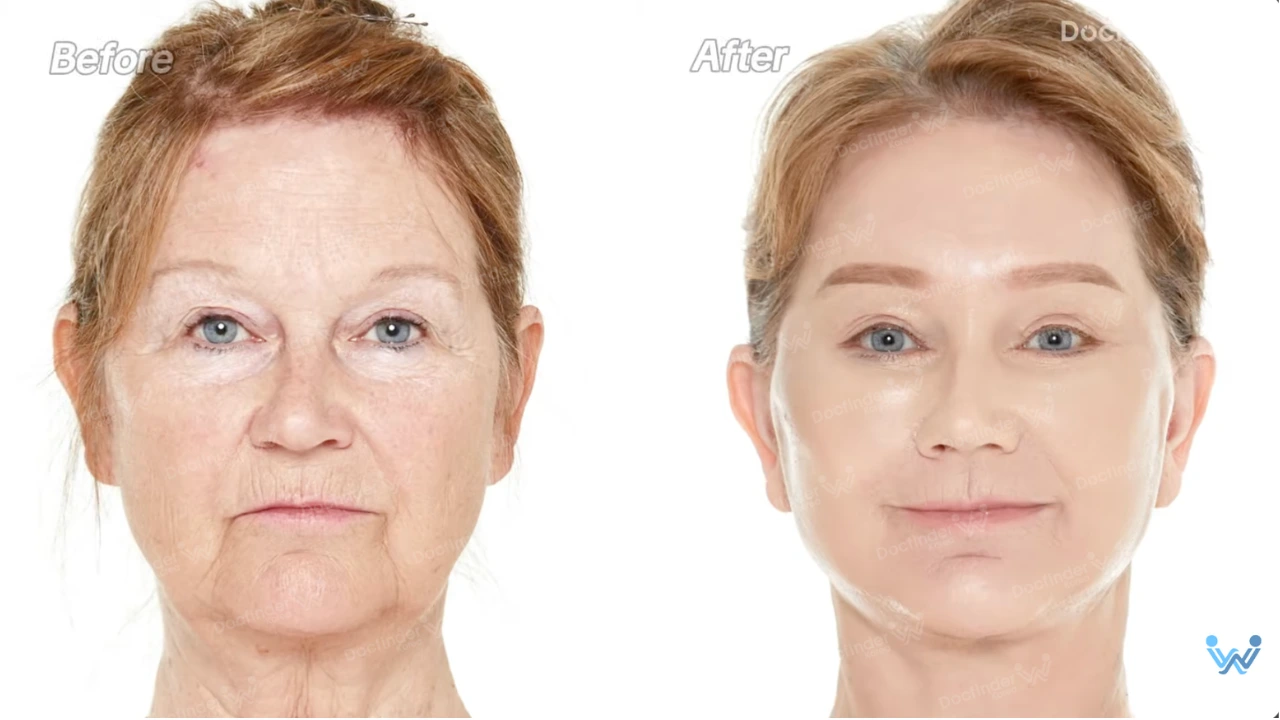
The neck was the centre of it. The incision face and neck lift addressed exactly the anatomy described earlier in this guide, repositioning the loosened platysma and redraping the skin, while the chin liposuction removed the fat pad blurring the line between her jaw and her throat. Those two together create the effect people notice immediately in her before and after: a jaw that ends in a defined edge instead of dissolving into the neck. The Fraxel laser then worked on surface texture, the part a lift alone never fixes, because a lift moves skin without changing its quality.
Doing It All in One Trip
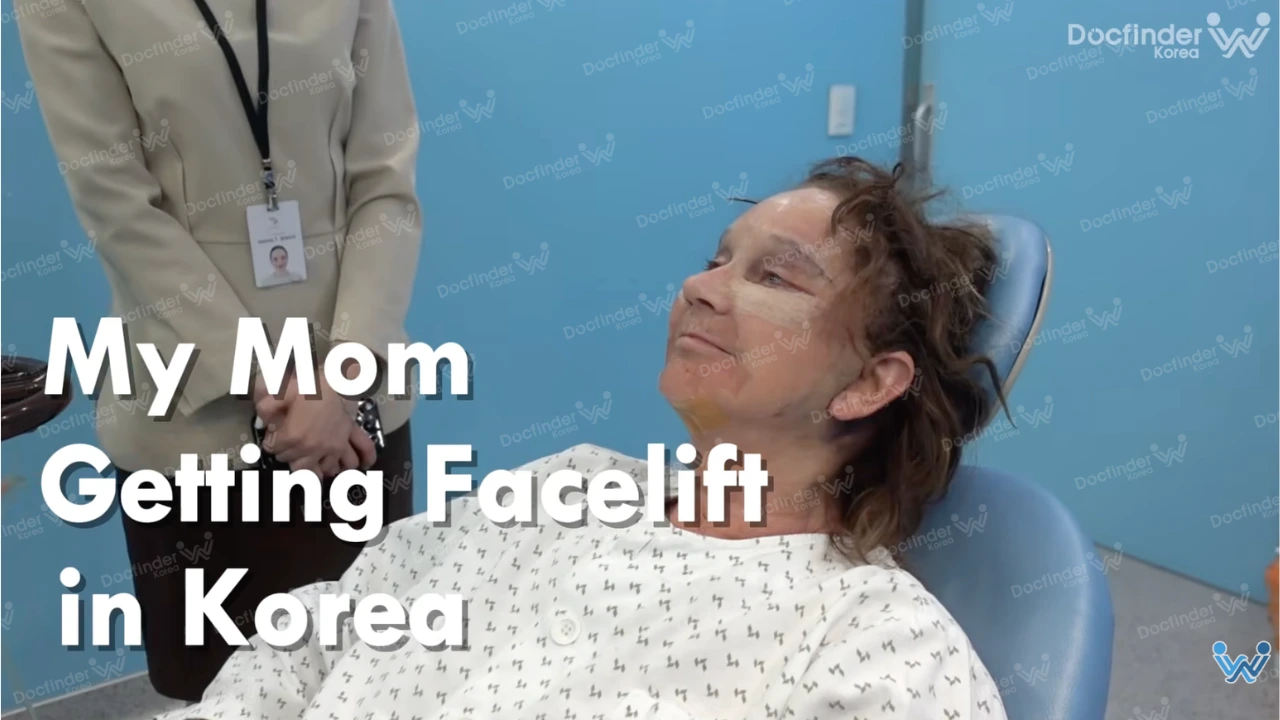
Combining that many procedures in one anaesthetic sounds daunting until you consider the alternative of four separate transpacific trips, four recoveries and four sets of time off. Korean anti-aging surgeons plan combinations routinely, sequencing the deep structural work first and finishing with the laser and skin work, and one general anaesthetic under a dedicated anesthesiologist is safer than several spread across years. The comments under Maria's video are mostly people reacting to how natural the outcome looks, which is the harder result to achieve and the one Korean technique is built around.
Why Maria Chose a Full-Care Agency, Not an App
Korean booking apps let you browse clinics and reserve a slot in a few taps. They are built for Korean residents who speak the language and can drive back for a check-up next Tuesday. For a patient flying in from abroad for an eight-procedure surgical day, book-and-go is the wrong model, because nobody in that arrangement is on your side of the table.
Docfinderkorea works as a Full-Care Agency instead, and the difference sits in three commitments. Direct Surgery Monitoring means a coordinator confirms that the surgeon you selected is the surgeon in the operating room. In-Person Hospital Accompaniment means someone is physically with you at consultations, on surgery day and at every follow-up, translating the medical detail rather than the pleasantries. All-Inclusive Recovery Care means the days after surgery are planned before you arrive.
Around that sits a 24/7 Premium Concierge: airport pickup, accommodation near the clinic, transport, medical translation, pharmacy runs and someone reachable at three in the morning when a new bruise appears. For Maria and her daughter it meant the trip could be about recovering together rather than navigating Gangnam with a compression band on. None of it is charged to the patient, because partner hospitals compensate the agency, which leaves Docfinderkorea free to act as your advocate, including when the honest answer is that the procedure you asked about is not the right one.
How to Book Neck Wrinkle Treatment in Korea: Step by Step
- Free online consultation. Send photographs from the front, the side and slightly below with a note on what bothers you; a coordinator returns surgeon options and an indicative price.
- Plan and quote. Agree on a route, a hospital and a date, and receive a written estimate before booking flights.
- Arrival. You are met at Incheon and taken to accommodation near the clinic.
- In-person consultation. The surgeon examines the platysma, skin quality and fat distribution, confirms the plan and orders blood work the same day.
- Treatment day with Direct Surgery Monitoring. A coordinator accompanies you and confirms the operating surgeon.
- First week. Compression band, dressing changes and daily check-ins, with transport handled for you.
- Stitch removal around day 7 to 10, then your surgeon's clearance to fly.
- Fly home with aftercare instructions in your language and remote follow-up with the same coordinator.
Neck Wrinkle Treatment Cost in Korea 2026: What You Actually Pay
Figures below are guidance ranges for Seoul in 2026, converted at the exchange rate on 4 August 2026, when one US dollar bought about 1,432 Korean won. Your quote depends on skin quality, the degree of laxity, the surgeon's tier and whether procedures are combined.
On the non-surgical side, botulinum toxin for platysmal bands generally runs 150,000 to 400,000 won, roughly 105 to 280 dollars per session. Regenerative injectables such as Rejuran fall between 300,000 and 600,000 won a session, roughly 210 to 420 dollars, with three sessions a typical course. Micro-focused ultrasound runs 600,000 to 1,200,000 won for the lower face and upper neck, roughly 420 to 840 dollars, while a full face and neck package sits between 1,500,000 and 2,500,000 won, roughly 1,050 to 1,750 dollars.
Surgically, neck liposuction alone is commonly quoted at 1,500 to 2,500 dollars in Seoul, a mini neck lift at 2,500 to 3,500, a standard SMAS neck lift at 3,500 to 5,000 and a deep plane neck lift at 5,000 to 7,500. Combining a neck lift with facial procedures, as Maria did, is quoted as a bundle rather than the sum of the parts, and international patients are frequently eligible for a ten percent VAT refund.
How That Compares Internationally
The American Society of Plastic Surgeons puts the average surgeon fee for a neck lift at 7,885 dollars, and that figure excludes anesthesia, facilities and related expenses; 2026 cost aggregates put the all-in United States total between roughly 5,000 and 12,000 dollars. Non-surgical work follows the same pattern, with micro-focused ultrasound on the neck typically 1,800 to 3,500 dollars in the United States and 3,000 to 5,000 for face and neck together, double to triple the Seoul range.
What the Korean Price Includes
A Korean surgical quote normally bundles the surgeon's fee, anesthesia with a full-time anesthesiologist, facility use, the compression garment, medication and follow-ups during your stay. Add flights and ten to fourteen nights of accommodation for surgery, five to seven for a non-surgical plan. Cheaper destinations exist, and the trade-off is aftercare and accountability. Docfinderkorea's coordination costs you nothing, because partner hospitals compensate the agency.
Neck Lift Recovery Timeline: Week by Week
Days 1 to 3
You wake with a compression band supporting the chin and neck, worn almost continuously. Expect tightness and swelling rather than sharp pain, controlled with prescribed medication, and sleep propped up on two pillows. For Maria this was the phase where having her daughter and a coordinator on call mattered most, since almost every question at this stage is a reassurance question.
Days 4 to 10
Bruising along the jaw and behind the ears peaks around day three or four and then fades. Sutures come out between day seven and day ten, and this is usually the appointment where patients first see the new jaw-to-neck line without dressings. Most people are presentable for a quiet dinner by day ten. Deswelling treatments and a scheduled follow-up sit inside this window.
Weeks 2 to 6
You are cleared to fly home, typically after the ten-day mark for combined surgery. Numbness under the chin is normal and resolves gradually, light walking resumes early and full exercise returns around week four to six. Roughly 60 to 70 percent of swelling is gone by the end of week two, which is when the result starts to look like the result.
Months 3 to 6
Scars mature from pink to pale and become difficult to find, residual tightness releases and the final contour settles. Where a laser was included, as in Maria's plan, skin texture keeps improving as new collagen forms. Non-surgical patients follow the same curve on a smaller scale, peaking around three months.
The Seoul Recovery Lifestyle
Seoul is unusually good at the fortnight after surgery. Pumpkin juice, or hobakjeup, is handed to post-operative patients in every Gangnam clinic as a local ritual for reducing swelling, and deswelling and lymphatic massage appointments are bookable within walking distance of most hospitals. Because the concierge handles transport, translation and appointments, the only thing on your schedule is healing, and patients travelling with family, as Maria did, often build the second week around gentle sightseeing once the compression band comes off.
Frequently Asked Questions About Neck Wrinkle Treatment
Can neck wrinkles be removed completely?
Softened substantially, yes; erased, rarely. Deep necklace lines that have been there for decades improve with resurfacing and regenerative injectables but usually remain faintly visible. Loose skin and standing bands respond dramatically to surgery, which is why realistic planning starts with naming which problem you have.
Do I need surgery or is non-surgical enough?
If you can pinch loose skin at the front of the neck and the cords stand out at rest, surgery gives a result devices cannot match. If the skin is still elastic and the concern is texture, early lines or a slightly soft jawline, non-surgical neck wrinkle treatment is usually enough and can be maintained for years.
How long do the results last?
A neck lift with platysmaplasty resets the clock and holds for roughly ten years, though skin continues to age normally afterwards. Micro-focused ultrasound lasts about twelve to eighteen months, regenerative injectables six to twelve months per course, and botulinum toxin three to four months.
Will I have a visible scar?
Incisions sit in the natural crease under the chin and behind the ears into the hairline. They are pink for the first few months and typically hard to locate by six months, because Korean surgeons keep the tension in the muscle layer rather than in the skin.
How many days do I need in Korea?
Five to seven days covers a non-surgical plan. Ten to fourteen suits a surgical neck lift, closer to fourteen for a combined face and neck programme like Maria's, since stitch removal and clearance to fly are the controlling factors.
Is it safe to travel to Korea for this?
Docfinderkorea places patients only in Ministry of Health and Welfare registered, KHIDI-listed hospitals with KSPRS board-certified surgeons, operating-room CCTV and a full-time anesthesiologist. You know the surgeon's name before you fly, and a coordinator attends every appointment. Many patients, like Maria, bring family and make it a shared trip.
Your Next Step
If the neck is the thing you notice in every photograph, the first step costs nothing. Send a few pictures and a note on what you would like to change, and a Docfinderkorea coordinator will come back with surgeon recommendations, an indicative price and an honest answer about whether non-surgical neck wrinkle treatment will get you there or whether surgery is the better use of your trip.
Docfinderkorea is a Ministry of Health and Welfare registered Full-Care Agency working with KHIDI-registered hospitals and KSPRS board-certified surgeons, with a 24/7 Premium Concierge, at no cost to you.
Request your free online consultation: https://docfinderkorea.com/quick-inquiry
Related Articles
Plastic Surgery Face Lift in Korea: The 2026 Ultimate Guide
What Are the Different Types of Facelift Surgeries in Korea?
Korean Plastic Surgery Before and After: The 2026 Guide to Real Transformations
Back