





Journal
Nose Surgery Before and After Pics: Your Ultimate 2026 Guide to the Seoul Nose
2026-02-23
Nose
Nose Surgery Before and After Pics: Your Ultimate 2026 Guide to the “Seoul Nose”
Summary
- Medical: Nose surgery before and after pics from Seoul show refined, natural results because Korean surgeons shape the nose around the whole face, not in isolation, and a primary rhinoplasty in Korea typically runs roughly 50–75% below comparable US prices.
- Technique: The 2026 difference is structure and planning, from 3D-CT mapping to the choice between open vs closed rhinoplasty and the use of your own septal, ear, or rib cartilage for a tip that stays soft and stable for life.
- Care: Docfinderkorea is a Ministry of Health and Welfare-registered Full-Care Agency offering Direct Surgery Monitoring, In-Person Hospital Accompaniment, All-Inclusive Recovery Care, and 24/7 Premium Concierge. We anchor this guide on Ricardo, a real patient who fixed a deviated septum and refined his nose in Seoul.
Quick Facts: Nose Surgery in Korea (2026)
- Surgery duration: about 1–3 hours, depending on whether it is a tip refinement, a full primary rhinoplasty, or a revision.
- Anesthesia: usually sleep (sedation) or general anesthesia, with a full-time anesthesiologist on site at accredited hospitals.
- Method: open or closed rhinoplasty, often combined with septal correction for patients who also have breathing issues.
- Materials: your own septal, ear, or rib cartilage, sometimes paired with a slim implant for the bridge.
- Splint and stitches: external splint for about 5–7 days; sutures removed around day 7.
- Time to result: most swelling settles by 1 month; the refined tip and final shape appear from 6 months to 1 year.
- Recommended stay in Seoul: about 7–14 days for surgery, splint removal, and early follow-up.
- Cost guidance: primary rhinoplasty roughly USD 2,100–3,500; complex or rib-cartilage cases USD 5,000–12,000; revision USD 2,700–7,000 and up.
Table of Contents
- Why Patients Choose Nose Surgery in Korea (2026)
- Decoding Nose Surgery Before and After Pics: What to Actually Look For
- Rhinoplasty Before and After: The Seoul Medical Edge
- Open vs Closed Rhinoplasty: Which Before and After Is Yours
- Ricardo’s Story: From Blocked Breathing to a Balanced Nose
- Why Ricardo Chose a Full-Care Agency, Not an App
- How to Book Nose Surgery in Korea: Step-by-Step
- Nose Surgery Korea Price 2026: What It Costs and How It Compares
- Rhinoplasty Recovery Timeline: Week by Week
- The Seoul Recovery Lifestyle
- FAQ: Nose Surgery Before and After in Korea
- Your Next Step
- Related Articles
Why Patients Choose Nose Surgery in Korea (2026)
If your saved folder is full of nose surgery before and after pics, you have already started the journey. Looking at a beautiful result is one thing; understanding how that person traveled from point A to point B, and how you can do the same safely, is where the real decision lives. That is what this guide is for.
In 2026, Seoul remains the world capital of rhinoplasty. South Korea performs an enormous volume of nose procedures every year and attracts hundreds of thousands of international patients, which means the top surgeons here are not generalists who occasionally do noses. They are specialists who operate on noses week after week, and that repetition shows up in the consistency of their before and after results. We call the signature outcome the “Seoul Nose”: refined, balanced, and so natural that friends assume you simply changed your skincare routine.
It helps to be clear about what nose surgery is and is not. A good rhinoplasty refines proportion and, when needed, restores breathing. It is not a filter and it will not turn one face into a completely different face. The best before and after pics look like the same person on a great day, which is exactly the goal.
Who is an ideal candidate for nose surgery in Korea?
- You are bothered by a specific feature: a hump, a wide or bulbous tip, a droopy tip, a deviated bridge, or a flat bridge that lacks definition.
- You have a functional concern such as a deviated septum or difficulty breathing, alongside or instead of a cosmetic goal.
- Your facial growth is complete (generally late teens and older) and you are in good general health.
- You want a natural, harmonious result rather than a dramatic, obviously “done” nose.
Throughout this guide we follow one real Docfinderkorea patient, Ricardo, who came to Seoul to fix a deviated septum and refine his nose at the same time. His experience makes the abstract concrete, from the first online consultation to the splint coming off.
Decoding Nose Surgery Before and After Pics: What to Actually Look For
Most people scroll galleries for the wow factor. To make an informed decision for your own face, you need to read the photos like a surgeon would. Here is how.
The Frontal View: Follow the Light
In a before photo, a wide or bulbous nose tends to swallow light, making the middle of the face look flat. In a strong after photo, look at the bridge: you should see a clean, slim line where the light catches. That highlight comes from narrowing the bony base and refining the cartilage at the tip. Check that the result looks symmetric and the nostrils do not look pinched or over-narrowed.
The Profile: The Secret Is in the Line
The profile is where most people fall in love with a result. For women, the popular 2026 line is mostly straight with a soft, feminine curve just before the tip. For men, the flattering line is straight and stable from top to bottom, strong without becoming a beak. When you compare profile before and after pics, trace the bridge with your eye and ask whether the line suits that person’s face, not just whether it is “small.”
The 45-Degree Angle: The View Real People See
The three-quarter angle is how others usually see you in daily life, so it is the most honest test. A nose can look good head-on and in profile but reveal structural problems at 45 degrees. If a gallery only ever shows perfect front and side shots, that is worth noticing.
Two Honesty Checks
- Ignore heavy filters. If the after photo has obvious beauty-mode smoothing, you cannot judge real skin texture or the true shape. You want to see real skin.
- Match your skin type. Thicker nasal skin holds swelling longer and cannot be made paper-thin, so look for before and after pics of people whose skin resembles yours to set realistic expectations.
Rhinoplasty Before and After: The Seoul Medical Edge
A big reason Korean rhinoplasty before and after pics look so refined in 2026 is the move away from “put in an implant and hope.” Today the emphasis is on structure, your own tissue, and planning.
Your Own Cartilage Does the Work
Septal cartilage from inside the nose and ear cartilage are the finishing materials surgeons use to shape a soft, natural tip you can still move. For a very flat or weak bridge, autologous rib cartilage builds height and lasting support using your own tissue, which your body accepts well. Many Seoul clinics use a hybrid approach: a slim implant for a smooth bridge combined with your own cartilage at the tip for safety and natural feel.
Facial Harmony, Not Just a Nose
Korean surgeons plan for total facial harmony. A nose that is technically “perfect” can still look wrong if it ignores the chin, forehead, and overall profile. A skilled surgeon may note that a slightly recessed chin makes a new high nose look even taller, and plan accordingly. This whole-face thinking is why after pics from Seoul so often look complete rather than just “nose done.”
3D-CT Planning and Revision Expertise
Korea is world-renowned for revision rhinoplasty, the hardest category, partly because surgeons use 3D-CT scans to see exactly what is happening under the skin before they begin. Revision before and after pics are often the most emotional, showing the journey from hiding a face to feeling like yourself again.
Safety You Can See
In Korea, safety is built into the experience as reassurance rather than fine print. Accredited hospitals operate with a full-time anesthesiologist, operating-room CCTV to confirm there are no “ghost doctors,” and surgeons who are board-certified by the Korean Society of Plastic and Reconstructive Surgeons (KSPRS). Docfinderkorea works only with KHIDI-registered hospitals. The result is simple: the surgeon you met is the surgeon who operates, from start to finish.
Open vs Closed Rhinoplasty: Which Before and After Is Yours
One question behind almost every set of before and after pics is the open vs closed rhinoplasty decision, because the technique shapes both the result and the recovery.
Closed Rhinoplasty
In closed rhinoplasty, all incisions are hidden inside the nostrils, so there is no external scar. It can mean slightly less swelling and a quick recovery, and it suits more limited changes such as a small hump reduction or modest bridge work. The trade-off is reduced visibility for the surgeon, so it is best for targeted, less complex goals.
Open Rhinoplasty
In open rhinoplasty, a tiny incision across the columella (the strip of skin between the nostrils) lets the surgeon fold back the skin and see the entire framework. This control is ideal for detailed tip work, structural grafting, rib-cartilage cases, and most revisions. The columellar scar typically fades to near-invisible. When you admire highly refined tip results in before and after pics, you are usually looking at open rhinoplasty.
Ricardo’s case is a good example of why this choice matters: correcting a deviated septum while also refining the nose calls for clear access to the internal structure, so the plan was built around what his anatomy actually needed rather than a one-size technique.
Ricardo’s Story: From Blocked Breathing to a Balanced Nose
Ricardo did not start his search dreaming about a new profile. He started it tired. For years, a deviated septum made breathing difficult during sleep and during exercise, the kind of problem that quietly drains your energy and follows you into every workout and every night’s rest. His main goal was practical: breathe better and feel more comfortable in daily life.
But like many patients, he also had a second, quieter wish. As long as a surgeon was going to work on his nose anyway, he hoped to refine its appearance for a more balanced, natural look. That combination, function first with aesthetics alongside, is one of the most common reasons people travel to Korea for nose surgery, and it is exactly the kind of case Seoul’s specialists handle every week.
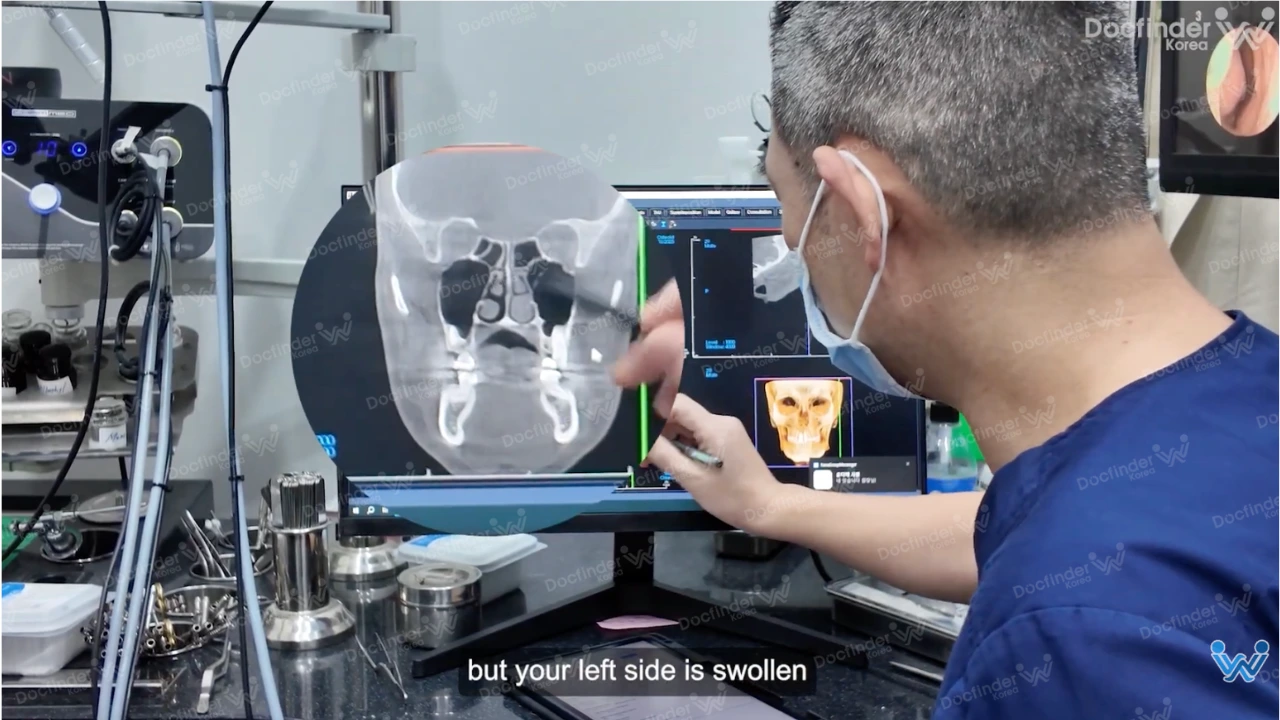
Ricardo’s journey began the way most Docfinderkorea journeys do, with a free online consultation from his own home. He shared photos and described his breathing problems, and his coordinator translated his goals into clear, surgeon-ready questions: what was causing the obstruction, what could realistically change about the shape, and how the two goals could be solved in a single, well-planned operation rather than two separate ones.

When he landed in Seoul, he was not left to navigate a foreign medical system alone. He was met, taken to his accommodation, and accompanied to his in-person consultation, where a coordinator stayed in the room to make sure the doctor heard exactly what he wanted and that Ricardo understood every part of the plan. For someone fixing a functional problem in another language, that translation and advocacy is the difference between hoping you were understood and knowing you were.
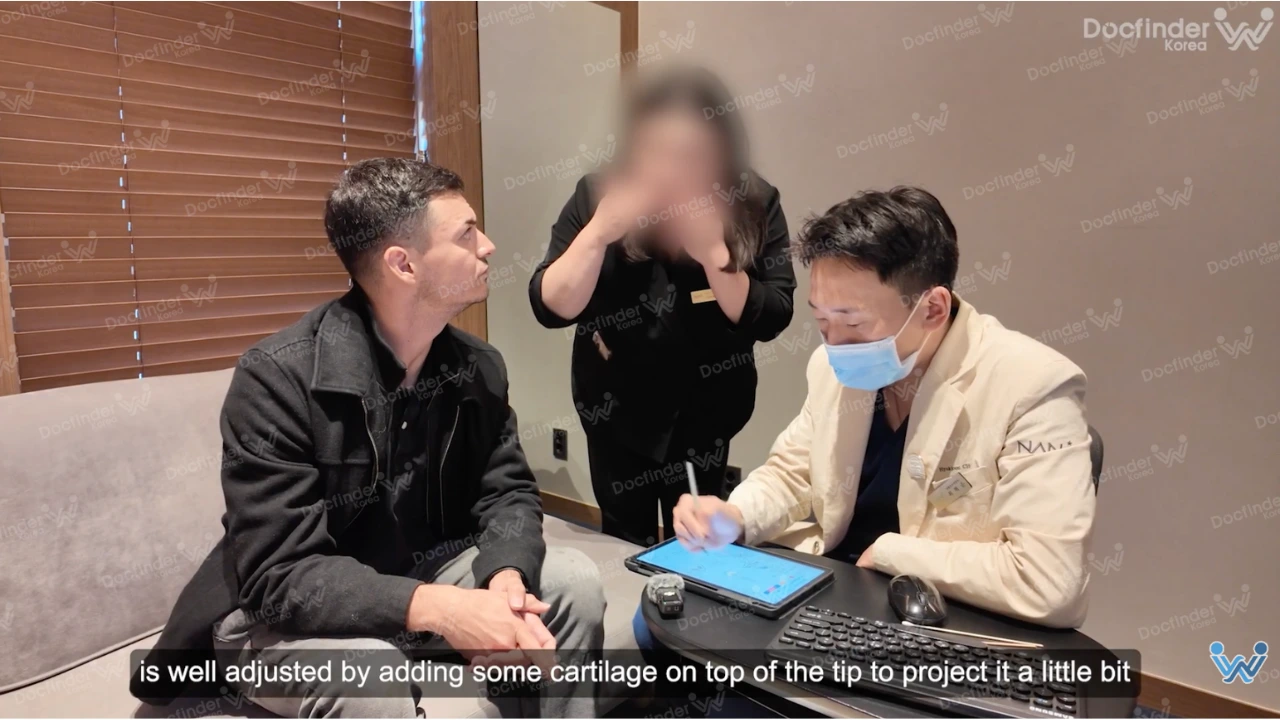
On surgery day, the plan addressed both the septum and the external shape. The functional correction was designed to open up his breathing, while the aesthetic refinement aimed for that balanced, natural line, not a dramatic transformation that would announce itself in every photo. This is the heart of what good before and after pics really represent: not a different person, but the same person, breathing easier and quietly more confident.
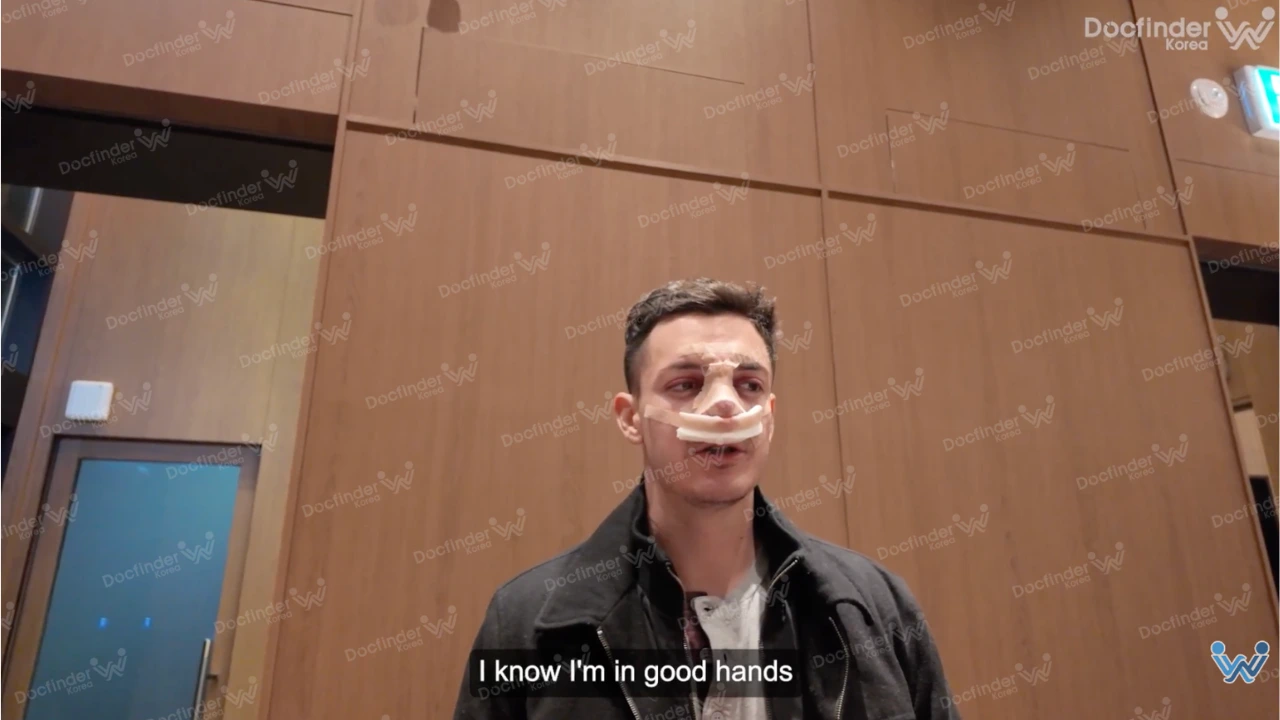
Ricardo documented the experience openly, including the parts the glossy galleries skip. There is the splint, the early puffiness, the strange novelty of breathing through your mouth for a couple of days. Then there is the reveal when the splint comes off, the slow week-by-week settling of swelling, and the growing realization that the nose in the mirror is starting to look like the one he had pictured. His honesty about the in-between stage is exactly why his video is worth watching before you book anything.
Why Ricardo Chose a Full-Care Agency, Not an App
Plenty of marketplace apps will show you nose surgery before and after pics and let you book a clinic in a few taps. Those tools are built mainly for domestic users who can read Korean, attend a quick consult, and go home the same day. For an international patient flying in for surgery, book-and-go is not enough, and that gap is exactly why Ricardo chose a Full-Care Agency.
Docfinderkorea is a Ministry of Health and Welfare-registered medical tourism agency, which means we act as the patient’s advocate, not the clinic’s sales desk. Our model rests on three pillars:
- Direct Surgery Monitoring: we confirm that the surgeon you chose is the one performing your operation, with no ghost-doctor substitution.
- In-Person Hospital Accompaniment: a coordinator goes with you to consultations and on surgery day, translating and making sure your goals and questions are fully heard.
- All-Inclusive Recovery Care: airport pickup, accommodation help, follow-up visits, and day-to-day support while you heal.
On top of that, a 24/7 Premium Concierge means there is always someone to answer the post-op question that arrives at 2 a.m. And here is the part that surprises people: our service comes at no extra cost to you, because the clinics pay the agency. You get an independent guide and translator without paying a markup for it.
How to Book Nose Surgery in Korea: Step-by-Step
- Free online consultation. Send your photos and describe your goals at docfinderkorea.com/quick-inquiry. We review them and outline realistic options.
- Clinic matching and direct quotes. We match you to specialists who fit your aesthetic and needs, then bring back direct quotes so there are no surprises.
- Airport pickup. You are met at Incheon and taken to your accommodation, with no taxi stress in a new city.
- In-person consultation. A coordinator stays with you so the surgeon hears exactly what you want and you understand the full plan, often confirmed with a 3D-CT scan.
- Surgery day with Direct Surgery Monitoring. We confirm your chosen surgeon is operating and support you before and after.
- Splint removal and early de-swelling. Around day 7 the splint and sutures come off; we help you through the first reveal and aftercare.
- Fly home with follow-up. We coordinate remaining check-ins and stay reachable through your 24/7 concierge as you continue to heal.
Nose Surgery Korea Price 2026: What It Costs and How It Compares
Pricing depends on the type of surgery, the materials, and whether it is a first operation or a revision, so treat the following as guidance ranges rather than fixed quotes. At the time of writing the exchange rate is roughly 1 USD to about 1,540 KRW, which shifts daily, so we always confirm current figures before sending you a quote.
In Seoul in 2026, a standard primary rhinoplasty generally runs about USD 2,100 to 3,500 (roughly 3.2 to 5.4 million KRW). A tip-focused refinement often falls a little lower, around USD 1,500 to 3,200. More complex structural work using your own rib cartilage typically ranges from about USD 5,000 to 12,000, and revision rhinoplasty, which is more demanding, commonly starts near USD 2,700 and rises to USD 7,000 or more depending on what needs to be rebuilt.
The global comparison is what makes those before and after pics so compelling. The same primary rhinoplasty in the United States typically costs about USD 10,000 to 22,000, so Korea often represents savings in the range of 50 to 75 percent. Compared with cheaper medical-tourism destinations, Korea’s appeal is value plus depth: a very high concentration of specialist surgeons, strong hospital accreditation, and structured aftercare, rather than the lowest possible sticker price. The cheapest tiers anywhere tend to carry a real “cheap but risky” trade-off, and a poor result can lead to a far more expensive revision later.
It is also worth remembering what the Korean price usually includes beyond the operation itself: the consultation, the procedure, and standard follow-up. With Docfinderkorea, coordination, translation, and accompaniment come at no extra cost because the clinic pays the agency. You should still budget separately for flights and accommodation and plan for roughly 7 to 14 days in Seoul.
Rhinoplasty Recovery Timeline: Week by Week
Those flawless after photos were not taken on day three. Understanding the real rhinoplasty recovery timeline, including the swelling stages, keeps your expectations healthy and your results in perspective.
Days 1–7: The Splint Week
You will wear an external splint and may have light internal support, with some puffiness and the odd sensation of breathing through your mouth. This is rest-and-recover time. For Ricardo, it was the stretch where the 24/7 concierge mattered most, because every small “is this normal?” question had a fast answer.
Day 7: The Reveal
When the splint and stitches come off, it is genuinely exciting, but you are still swollen, so the bridge can look higher and wider than the final result. This is the start of the shape, not the finish.
Weeks 2–4: Back to Life
Visible bruising and major swelling fade, and most people feel comfortable in public and even start taking selfies again. The nose is settling but the tip is still firming up.
Months 1–3: The Shape Emerges
The bulk of the swelling resolves and the new proportion becomes clear. This is usually when before and after comparisons start to look like the result you imagined.
Months 6–12: The Real After
The tip becomes its most defined, residual swelling disappears (it lingers longest in thicker skin), and the final, lasting shape settles in. The after pic worth comparing to your before is the one taken here.
The Seoul Recovery Lifestyle
Recovering in Seoul is part of why patients enjoy the process. Local recovery culture leans on gentle staples like pumpkin juice (hobakjeup), widely used to help with de-swelling, and easy-to-eat Korean porridge in the first days. Gangnam, where many top clinics sit, is famously convenient: pharmacies, de-swelling and skincare clinics, cafes, and your accommodation are often within a short walk.
Because the concierge handles logistics, transport, translation, appointment scheduling, and the steady stream of small questions, you get to do the one thing that actually matters after surgery: rest and heal. Light walks, good food, and a calm hotel room beat worrying about taxis and forms every time.
FAQ: Nose Surgery Before and After in Korea
Will my result look as natural as the before and after pics?
That is the goal of the Seoul Nose: a result that looks like you on a great day. Bring real, unfiltered reference photos to your consultation and choose a surgeon whose gallery matches the natural style you want.
Does nose surgery hurt?
Most patients describe pressure and congestion, like a very blocked nose, rather than sharp pain. You are asleep for the surgery, and the main early nuisance is breathing through your mouth for a day or two.
Should I choose open or closed rhinoplasty?
It depends on your goals and anatomy. Closed suits limited, targeted changes; open gives the surgeon full access for detailed tip work, structural grafting, and revisions. A 3D-CT consultation helps decide.
How much does nose surgery in Korea cost?
As a guide, primary rhinoplasty is roughly USD 2,100 to 3,500, complex rib-cartilage cases USD 5,000 to 12,000, and revisions from about USD 2,700 upward. Send your photos for a direct, current quote.
How long should I stay in Seoul?
Plan for about 7 to 14 days, which covers surgery, splint and stitch removal around day 7, and early follow-up before you fly home.
Are the results permanent?
Yes. Once swelling fully resolves over 6 to 12 months, the structural result is lasting, especially when your own cartilage is used.
Can I fix breathing and appearance at the same time?
Often, yes. Functional correction such as a deviated septum can be combined with cosmetic refinement in one operation, which is exactly what Ricardo did.
Is it safe to travel for surgery alone?
With a Full-Care Agency you are never really alone. Ricardo flew in and had pickup, in-person accompaniment, translation, and 24/7 support from the moment he landed.
Your Next Step
You have done the research and studied the nose surgery before and after pics. The next step is finding out what your own after could look like. Send your photos for a free, no-pressure online consultation at docfinderkorea.com/quick-inquiry and we will give you honest, realistic guidance and direct quotes.
Docfinderkorea is a government-certified, Ministry of Health and Welfare-registered Full-Care Agency with 24/7 Premium Concierge support, and our service comes at no extra cost to you. Our expertise is certified, and our focus is entirely on your safe, confident result.
Related Articles
Why Korean Nose Jobs Are Popular Among International Patients
Comprehensive Guide to Types of Nose Jobs in Korea (2026 Edition)
Bulbous Nose Job Before and After: Roxana’s Seoul Journey 2026
Back