






Journal
Face Slimming Surgery in Korea: The 2026 Ultimate Guide
2026-03-28
Facial Contouring
Face Slimming Surgery in Korea: The 2026 Ultimate Guide
Summary
- Medical: Face slimming surgery narrows the face by reshaping bone, removing deep cheek fat, or lifting sagging tissue, depending on what is actually making the face look wide. In Seoul it costs 40 to 60 percent less than the same work in the United States.
- Technology: Korean surgeons plan on 3D CT data and cut with ultrasonic piezo instruments that shape bone without tearing the nerves around it, which is why V-line jaw surgery Korea results look sculpted rather than hollow.
- Care: Larisa, 50, flew to Seoul for cheekbone reduction combined with a full facelift, neck lift, forehead lift and lower blepharoplasty, supported by Docfinderkorea's Full-Care Agency model at no extra cost.
Quick Facts: Face Slimming Surgery in Korea (2026)
- Surgery duration: 40 minutes for buccal fat removal, 2 to 4 hours for bone contouring.
- Anesthesia: general anesthesia with a full-time anesthesiologist for bone work; IV sedation for fat and muscle procedures.
- Incisions: hidden inside the mouth, so nothing is visible on the face.
- Stitch removal: day 5 to day 10. Compression band worn most of the day for two to four weeks.
- Time to result: presentable at 2 to 3 weeks, refined at 3 months, final at 6 to 12 months.
- Recommended stay in Korea: 14 days for bone contouring, 7 to 10 days for soft tissue only.
- Guidance price in Seoul: 1,500,000 to 26,000,000 KRW, roughly 1,000 to 18,000 USD.
Table of Contents
- Why Patients Choose Face Slimming Surgery in Korea in 2026
- Face Slimming Surgery in Korea: The Medical Edge in 2026
- V-Line Jaw Surgery Korea: Reshaping the Lower Third
- Larisa's Story: A New Face at 50, After One Trip to Seoul
- Why Larisa Chose a Full-Care Agency, Not an App
- How to Book Face Slimming Surgery in Korea: Step by Step
- Face Slimming Surgery Cost in Korea 2026: What You Actually Pay
- Cheekbone Reduction Recovery Timeline: Week by Week
- The Seoul Recovery Lifestyle
- Frequently Asked Questions About Face Slimming Surgery
- Your Next Step
- Related Articles
Why Patients Choose Face Slimming Surgery in Korea in 2026
A wide face is rarely one problem. It can be bone, it can be fat, it can be an overdeveloped chewing muscle, and after forty it is often deep tissue that has slipped downward and pooled along the jaw. Face slimming surgery is the umbrella term for the operations that fix each of those causes, and the art lies in identifying which one you have.
This is where South Korea built its reputation. Gangnam hospitals are registered with the Korea Health Industry Development Institute for international patients, surgeons are board certified through the Korean Society of Plastic and Reconstructive Surgeons, and a single specialist may perform several hundred bone cases a year. This work is measured in millimeters, and millimeter work rewards that repetition.
What Face Slimming Surgery Is, and What It Is Not
Face slimming surgery changes the outline of your face, not your weight. Bone surgery cannot fix loose skin, and a lift cannot narrow a wide jawbone. The most common disappointment in facial contouring comes from choosing the right operation for the wrong cause, which is what a 3D CT consultation prevents. The maximum-reduction era has also given way to what Seoul surgeons call precision naturalism: removing less bone in a smarter place, and supporting the soft tissue on top of it.
Who Is an Ideal Candidate?
- Your face reads as square or wide across the jaw angles from the front.
- Your cheekbones project sideways and cast a shadow beneath them.
- You have lower-cheek fullness that stays even when the rest of you is lean.
- Your jaw muscle bulges when you clench and botox no longer holds it.
- You are over forty and the width sits low, where tissue has descended.
- You are at a stable weight and want a narrower outline, not a different face.
Larisa, 50, is the patient this guide follows from consultation to result, and she belonged to that fifth category.
Watch Larisa's full journey:
Face Slimming Surgery in Korea: The Medical Edge in 2026
Cheekbone Reduction, Done From Two Points
Cheekbone reduction narrows the upper and middle face by cutting the zygomatic arch in two places, sliding the complex inward and backward, then fixing it with titanium plates. The front incision is inside the mouth and the rear one behind the sideburn hairline. Fixation at both points is the critical detail: reduce the front only and the arch is left unsupported, which produced the cheek drooping older techniques were criticized for. Larisa's plan used this approach so her midface would sit narrower without losing height.
Buccal Fat Removal and Masseter Reduction
Beneath the cheek muscle sits a pad of fat that does not shrink with dieting. Removing part of it through a small incision inside the mouth sharpens the transition into the jaw, and Korean surgeons take a portion rather than the whole pad because it cushions the midface as you age. If instead the widest point of your face is the muscle you feel bulge when you clench, botulinum toxin injected into the masseter slims the lower face within six weeks.
Lifting as a Slimming Procedure
For patients over forty-five, the most effective face slimming surgery is often not subtractive at all. When the deep facial layer descends it pools along the lower cheek and jaw, adding width exactly where you do not want it. A deep-plane facelift repositions that layer upward and backward and the face immediately reads narrower in profile. This is why Larisa's plan paired cheekbone reduction with a facelift.
The Safety Layer Korean Hospitals Build In
Every bone case is planned on a 3D CT scan, so the surgeon knows the position of the nerve canal before the first cut, and cutting is done with ultrasonic piezoelectric instruments that divide bone while leaving nerves and vessels untouched. Operating rooms carry CCTV patients can request, the surgeon who gave your consultation is the surgeon who operates, and a full-time anesthesiologist stays in the room throughout.
V-Line Jaw Surgery Korea: Reshaping the Lower Third
If the lower third of your face is the problem, V-line jaw surgery Korea is the procedure that made Seoul famous. It reshapes the mandible so the jawline tapers to a defined chin instead of squaring off at the angles, and it is the most requested face slimming surgery among international patients arriving in Gangnam.
Long-Curve Ostectomy and Cortical Shaving
Older jaw reduction cut off the mandibular angle, which often left a secondary corner further forward that photographed worse than the original. The Korean standard is now a long-curve ostectomy: one continuous curved cut running from behind the ear toward the chin, so the finished jawline is a smooth arc. That narrows the jaw from the side; cortical shaving of roughly two millimeters along the body of the mandible delivers the narrower front view. Every incision is inside the mouth, so V-line jaw surgery Korea leaves no visible scar.
Mini V-Line for Patients Who Need Less
Patients whose jaw angles are already soft but whose chin is wide or short are better served by a mini V-line, addressing the chin alone through a T-shaped genioplasty. A good Korean surgeon will tell you when the smaller operation is the right one, and Docfinderkorea's coordinators arrange second opinions when two clinics disagree on scope.
Larisa's Story: A New Face at 50, After One Trip to Seoul
Larisa is fifty. She had spent years watching a face in the mirror that no longer matched how she felt, and her description of what she wanted was refreshingly free of the language people usually use about surgery. She did not want to look like someone else, and she did not want to look twenty-five.
"I wanted to feel like myself again, just a softer, more refreshed version," she said during her initial consultation.

That sentence turned out to be the whole surgical brief. What was making her face look heavier was a combination: cheekbones projecting wider than her lower face could balance, and a deep tissue layer that, as in most faces at fifty, had descended and settled along the jaw and neck. Slimming the bone alone would have narrowed the middle of the face while leaving the sagging that made it look wide at the bottom. Lifting alone would have tightened the outline but left the cheekbones as wide as they were. She needed both, in one trip, under one anesthesia.
Two Surgeons, One Plan
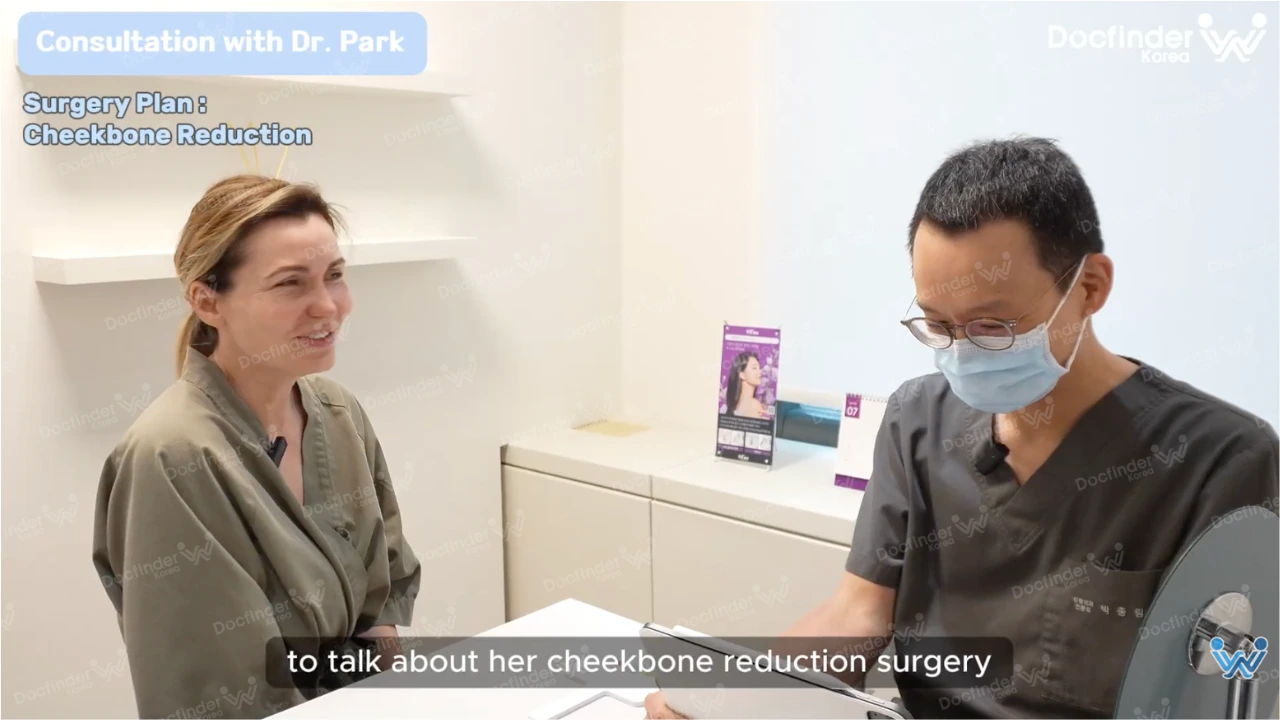
Her consultations were split between two specialists, standard practice in Korea for combined facial cases. Dr. Park handled the bone side and walked her through cheekbone reduction: where the two cuts would sit, how the arch would be moved inward and fixed with plates, and why more reduction would not have made her look better. Dr. Han then mapped out the soft-tissue plan: a full facelift, a neck lift, a forehead lift and a lower blepharoplasty. Once the bone footprint changed, the tissue above it had to be redraped to match, otherwise the reduction would simply create slack. Both surgeons reviewed the same 3D imaging, and Larisa left with one unified plan rather than two opinions she was expected to reconcile herself.
Surgery Day and the First Week
Combined bone and lifting surgery is a long day. Larisa was under general anesthesia with a dedicated anesthesiologist present throughout, and her Docfinderkorea coordinator stayed at the hospital for the entire procedure under the agency's Direct Surgery Monitoring policy. Someone whose only job was to represent her was present, receiving updates from the surgical team and available the moment she woke up. For a patient thousands of miles from anyone she knows, that is difficult to overstate.
The first seventy-two hours are the hardest part of any facial surgery. Swelling peaks around day three, the compression band feels relentless, and the face in the mirror looks nothing like the outcome. Larisa's coordinator was at the hospital daily, handling the translation of every instruction, the pharmacy runs, the soft food, the follow-up scheduling, and the reassurance that the alarming stage was the normal stage. This is where patients who booked through an app tend to panic.
The Result, in Her Words
By the time Larisa was cleared to fly home, the swelling had dropped enough for the new outline to show: a narrower midface, a jaw and neck line lifted back to where they used to sit, and eyes that no longer looked tired.
"I didn't just change my face; I changed the way I look at the world. I feel lighter, more confident, and finally, my outside reflects the energy I feel on the inside."
That is what the 2026 approach to face slimming surgery is designed to produce. Not a face that announces it has been operated on, but one that finally matches the person wearing it.
Why Larisa Chose a Full-Care Agency, Not an App

Most people researching surgery in Korea find the marketplace apps first. Gangnam Unni and Babitalk are useful for what they were built to do: help Korean-speaking residents of Seoul compare prices and book appointments. Once you have booked, you are on your own. That model breaks down for an international patient having face slimming surgery, where you face general anesthesia, bone work, a two-week recovery in a language you do not speak, and clinical decisions that need translating in both directions. A booking link does not help at three in the morning on day two.
The Three Pillars
- Direct Surgery Monitoring: a representative stays at the hospital for the duration of your operation, in contact with the surgical team, so you are represented while you are unconscious.
- In-Person Hospital Accompaniment: a coordinator attends every consultation, the surgery day and every follow-up, interpreting the medical conversation rather than leaving you with a translation app.
- All-Inclusive Recovery Care: deswelling treatments, medication, aftercare scheduling, transport and accommodation guidance organized as one package.
What It Costs You
Nothing. Docfinderkorea is compensated by its partner hospitals, so you pay the clinic's own price. Because the agency is registered with Korea's Ministry of Health and Welfare and works only with KHIDI-registered hospitals and KSPRS board-certified surgeons, it has a standing to advocate for you that an app booking never confers. When Larisa needed two surgical specialties coordinated into one plan and one operating day, that was the difference between a coherent treatment and a scheduling problem.
How to Book Face Slimming Surgery in Korea: Step by Step
- Free online consultation. Send front, side and 45-degree photographs and a note on what bothers you. A coordinator returns surgeon recommendations, a candid assessment of whether bone, fat, muscle or lifting is the real cause, and indicative pricing.
- Plan and schedule. You choose the clinics, and the agency books consultations, surgery and follow-ups around your flights.
- Arrival and airport pickup, with accommodation near the clinic in Gangnam.
- In-person consultation and 3D CT. The surgeon confirms or revises the plan, with your coordinator interpreting. Nothing is signed until you understand it.
- Surgery day with Direct Surgery Monitoring: pre-operative testing, general anesthesia with a dedicated anesthesiologist, coordinator on site throughout.
- The first week: near-daily contact, deswelling care, medication management and the first post-operative check, with the 24/7 Premium Concierge reachable at any hour.
- Stitch removal and clearance to fly around day 7 to 10, then remote follow-up at one, three and six months.
Face Slimming Surgery Cost in Korea 2026: What You Actually Pay
Face slimming surgery cost in Korea 2026 depends on which layer is being treated. The figures below are guidance ranges from Seoul clinics rather than quotations, and each moves with the surgeon's seniority, your anatomy and whether procedures are combined. Conversions use approximately 1,442 Korean won to one US dollar, the rate in early August 2026.
Buccal fat removal generally runs 1,500,000 to 3,500,000 won, roughly 1,000 to 2,400 US dollars, and masseter botulinum toxin is 150,000 to 400,000 won per session. Cheekbone reduction, the procedure Larisa had, falls between 5,500,000 and 11,000,000 won, approximately 3,800 to 7,600 dollars. Basic jaw reduction with cortical shaving sits at 8,000,000 to 13,000,000 won, about 5,500 to 9,000 dollars. Full V-line surgery combining jaw and chin runs 12,000,000 to 20,000,000 won, around 8,300 to 13,900 dollars, and a complete plan covering jaw, chin and cheekbone together is usually quoted at 16,000,000 to 26,000,000 won, roughly 11,100 to 18,000 dollars. Combining bone work with a facelift, as Larisa did, is priced case by case above that band.
How Korea Compares Internationally
The same jaw contouring in the United States is commonly quoted at 15,000 to 30,000 dollars and American cheekbone reduction at 10,000 to 20,000, putting Korean pricing roughly 40 to 60 percent lower. Thailand quotes cheekbone reduction at around 4,000 to 7,000 dollars and Mexico at 4,500 to 8,500, so Korea is not the cheapest option on paper. What Korea offers is the highest concentration of surgeons performing this operation daily and aftercare treated as part of the treatment. In bone surgery, where a revision costs more than the original, that is where the value sits.
What the Korean Price Includes
A Seoul quotation normally covers the surgeon's fee, anesthesia, the operating room, pre-operative testing, the 3D CT scan, medication and the scheduled post-operative visits including deswelling care. It does not cover flights, accommodation or meals, so budget an additional 1,500 to 3,000 dollars for a two-week stay. Foreign patients can also claim a value-added tax refund of up to ten percent.
Cheekbone Reduction Recovery Timeline: Week by Week
The cheekbone reduction recovery timeline is the part patients underestimate. Bone heals on its own schedule, and knowing what each stage looks like is the best defense against the day-three panic that catches almost everyone.
Days 1 to 3: Peak Swelling
Swelling rises steeply and peaks around the third day. The face is tight, numb in patches and largely unrecognizable. A compression band is worn almost continuously, diet is liquid, and numbness across the cheek and upper lip is expected and temporary. This is the stage Larisa's coordinator managed day by day.
Week 1: The Turn
Swelling falls from around day four, and by the end of the first week most patients look swollen rather than alarming. Stitches inside the mouth are removed or begin dissolving between day 5 and day 10, and the first deswelling sessions begin: lymphatic drainage, LED therapy and, at some clinics, hyperbaric oxygen. Diet moves to soft foods.
Weeks 2 to 4: Presentable
Here the cheekbone reduction recovery timeline starts to feel rewarding. Bruising has resolved, the band is worn mainly at night, and most patients are comfortable in public and back to desk work. The narrower outline is clearly visible despite residual swelling, and patients combining bone work with a lift, as Larisa did, see the change most dramatically in profile.
Months 2 to 12: Refinement and Final Result
Deep swelling resolves slowly, the soft tissue settles onto the new bone contour, chewing is normal again and any remaining numbness clears as sensory nerves recover. Most patients would say the result looks finished by month three, and bone union completes over the following months, when definition around the cheekbone and jaw is sharpest. The change is permanent: reduced and fixed bone does not grow back.
The Seoul Recovery Lifestyle
Recovering in Seoul is easier than recovering from the same surgery at home. Pumpkin juice, hobakjeup, is handed to every facial surgery patient in the country and sold in every convenience store for reducing fluid retention. Deswelling clinics offering lymphatic massage, LED and oxygen therapy sit on practically every block in Gangnam, and soft-food delivery, 24-hour pharmacies and the clinic itself are usually within a few hundred meters of the accommodation an agency arranges. For Larisa that proximity mattered: with appointments, deswelling sessions, pharmacy and food all handled, the only thing left on her list was healing.
Frequently Asked Questions About Face Slimming Surgery
Will I have visible scars after face slimming surgery?
No. Jaw, chin and cheekbone incisions are made inside the mouth, and cheekbone reduction adds a small incision hidden behind the sideburn hairline. Facelift incisions follow the natural creases around the ear and fade to fine lines.
Is face slimming surgery permanent?
The bone changes are permanent, and buccal fat removal is too, since the removed fat does not return. Masseter botulinum toxin is the only temporary option.
How long should I stay in Korea?
Fourteen days is the working minimum for bone contouring, covering consultation, surgery, peak swelling, stitch removal and clearance to fly. Soft-tissue-only procedures need seven to ten days.
Which procedure do I actually need?
That depends on whether your width comes from bone, fat, muscle or descended tissue, and you cannot reliably tell from a photograph. A 3D CT scan and an in-person examination settle it.
Can face slimming surgery be combined with other procedures?
Yes, and combining usually makes sense: one anesthesia, one recovery, one trip. Larisa combined cheekbone reduction with a facelift, neck lift, forehead lift and lower blepharoplasty.
Will my face sag after bone reduction?
This was a fair concern with older single-point techniques that left the bone unsupported. Two-point fixation and, where indicated, simultaneous lifting have made it uncommon.
Is it safe to travel to Korea alone for surgery?
Larisa did exactly that at fifty, with no Korean language ability and no companion. With a registered agency at every appointment, monitoring your surgery and reachable around the clock, traveling solo is common and entirely workable.
Your Next Step
If you have been wondering which part of your face to change, the useful first step is finding out what is actually causing the width, and that costs nothing. Send a few photographs and a note on what you would like to be different, and a Docfinderkorea coordinator will come back with surgeon recommendations, indicative pricing for the procedures that apply to you, and an honest answer about what face slimming surgery can deliver in your case.
Docfinderkorea is a Ministry of Health and Welfare registered Full-Care Agency working with KHIDI-registered hospitals and KSPRS board-certified surgeons, with a 24/7 Premium Concierge, at no cost to you.
Request your free online consultation: https://docfinderkorea.com/quick-inquiry
Related Articles
The Difference between V-line & Mini V-line Surgery: Which is Right for You?
Buccal Fat Removal: What it is, Recovery & Before & After
Cost Comparison: Plastic Surgery in Korea vs. Other Countries
Back