






Journal
Plastic Surgery Eye in Korea: 2026 Guide to Natural Results
2026-02-03
Eyes
Plastic Surgery Eye in Korea: 2026 Guide to Natural Results
The eyes are often referred to as the windows to the soul, and in the realm of aesthetic enhancement, they are the most defining feature of facial harmony. As we move through 2026, the landscape of plastic surgery eye procedures in South Korea has undergone a profound transformation. What was once a pursuit of a simple crease has evolved into a sophisticated blend of biometric analysis, regenerative medicine, and high-artistry design.
At Docfinderkorea, we have witnessed the evolution of these techniques firsthand. As a government-certified agency, our role is to demystify the complex world of Korean medical tourism for international patients. This guide is designed to provide you with an exhaustive understanding of why Korea remains the undisputed global leader in ocular aesthetics and how we ensure your journey is safe, professional, and life-changing.
The 2026 Paradigm Shift: From "Modification" to "Harmonization"
For decades, the goal of many was to emulate specific eye shapes. However, the current trend in Seoul—the epicenter of global plastic surgery—is "Individualized Harmonization." This means surgeons no longer look at the eye in isolation. Instead, they analyze the thickness of the skin, the strength of the levator muscle, the depth of the orbital bone, and even the patient's habitual facial expressions.
The "Ideal Eye" of 2026 is characterized by three factors:
- Dynamic Naturalism: The crease should look natural not just when the eye is open, but especially when it is closed or blinking.
- Lively Clarity: Addressing the "sleepy" look by maximizing the visible area of the pupil without over-exposing the white of the eye (sclera).
- Horizontal Balance: Ensuring the distance between the eyes matches the width of the eye itself, creating a balanced "Golden Ratio."
In-Depth Analysis of Asian Blepharoplasty Techniques
Asian Blepharoplasty, or double eyelid surgery, is the cornerstone of Korean ocular surgery. While the basic concept remains the same, the precision of the tools and the refinement of the sutures in 2026 have reached unprecedented levels.
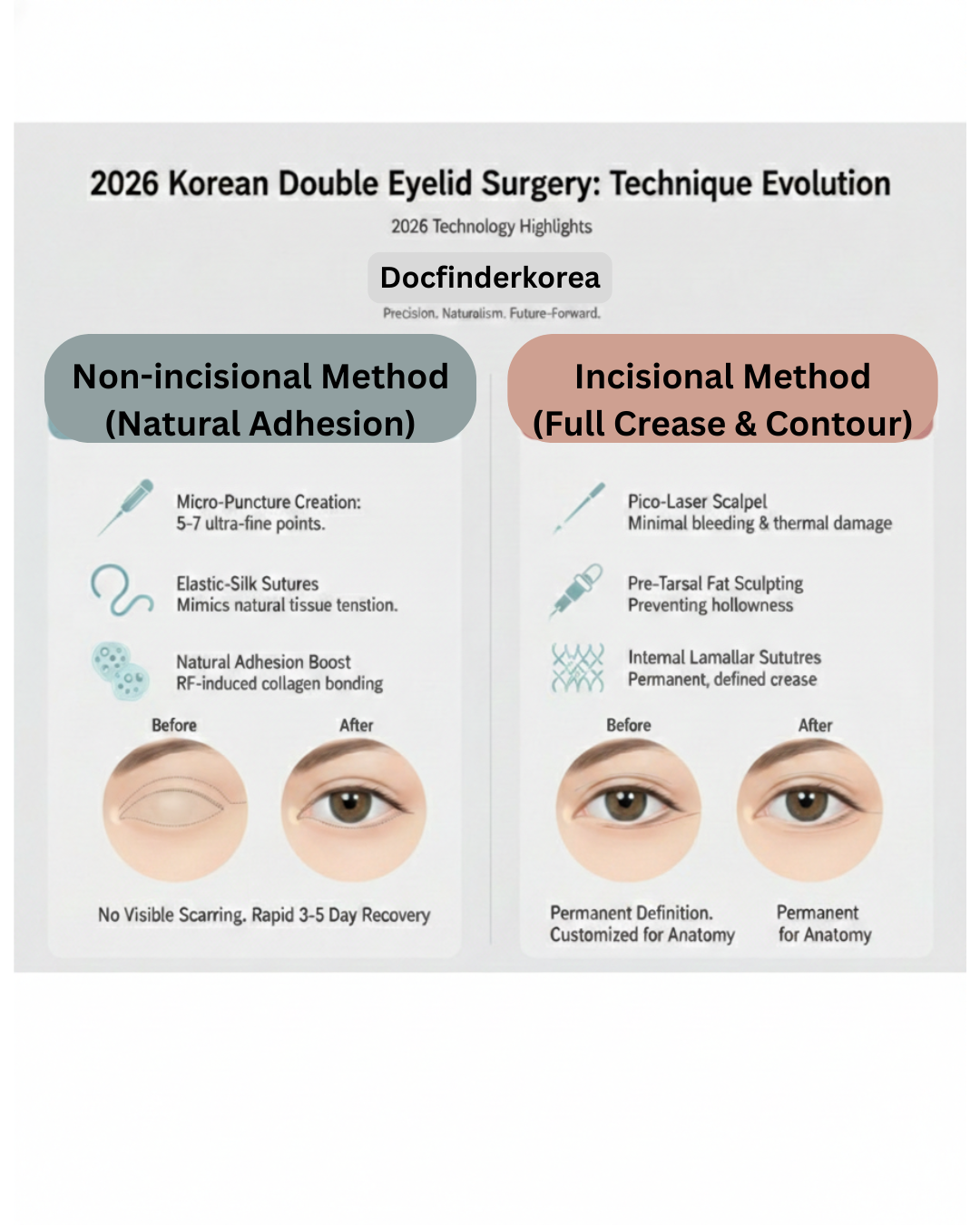
1. The Natural Adhesion Method (Advanced Non-Incisional)
Unlike traditional "stitching" that could easily unfasten, the 2026 Natural Adhesion technique involves making 5 to 7 microscopic punctures. Instead of a simple thread holding the skin, these punctures encourage the natural adhesion of the skin's dermal layer to the underlying levator muscle.
- Best For: Individuals with thin eyelid skin and minimal fat who want a "no-trace" result.
- The 2026 Advantage: The use of "Elastic-Silk" sutures that mimic the natural tension of human tissue, significantly reducing the "pulling" sensation during recovery.
2. The Micro-Incisional and Full Incisional Methods
For those with thicker skin or "puffy" eyes (caused by an excess of orbital fat or ROOF—Retro-Orbicular Oculi Fat), an incision is necessary. Modern Korean surgeons utilize laser scalpels that minimize bleeding and thermal damage to the surrounding tissue.
- Micro-Incision: A tiny 2-3mm opening used to remove fat before securing the crease with sutures.
- Full Incision: Allows for the comprehensive restructuring of the eyelid. In 2026, this is often paired with "Pre-tarsal Fat Repositioning" to prevent the hollowed-out look that can occur with traditional fat removal.
Ptosis Correction & Canthoplasty: The "Bright Eye" Revolution
A common mistake many patients make is assuming that a double eyelid crease will fix a tired appearance. In many cases, the culprit is Ptosis—a weakness in the muscle that lifts the eyelid.
The Medical Necessity of Ptosis Correction
If your upper eyelid covers more than 2mm of your pupil, you have ptosis. This condition often leads to chronic forehead wrinkles because you are constantly using your eyebrows to see better. 2026 techniques for Ptosis Correction focus on "shortening" or "advancing" the levator muscle.
- Non-Incisional Ptosis Correction: This has become the preferred choice for mild to moderate cases. It is performed through the inside of the eyelid, leaving no external scar and offering a dramatically faster recovery.
The Geometry of Canthoplasty
To truly enlarge the eyes, surgeons often recommend Canthoplasty to adjust the horizontal dimensions.
- Epicanthoplasty: Refines the inner corner. In 2026, the "Z-plasty" and "Skin-Redraping" methods are the standard, designed to eliminate the Mongolian fold while preserving the natural red caruncle.
- Dual Canthoplasty (Lateral + Lower): This is a signature Korean technique. By lowering the outer corner of the eye, it creates a larger, softer, and more feminine "almond" shape. It is particularly effective for those with "sharp" or upwardly slanted eyes that give a harsh impression.
The Role of Technology in Surgical Planning
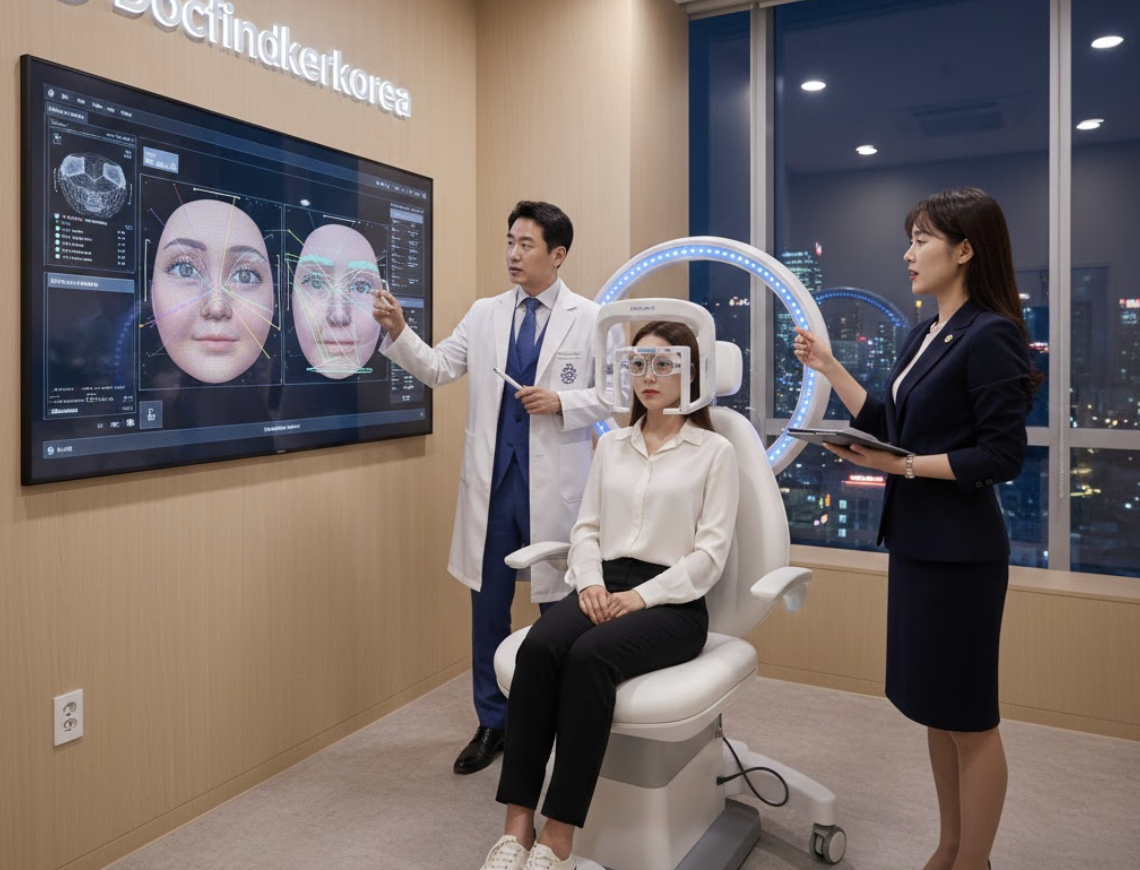
In 2026, a consultation at a top-tier Korean clinic feels like stepping into a sci-fi lab. High-resolution 3D cameras capture the face from 360 degrees to show how they will interact with the patient's unique anatomy.
At Docfinderkorea, we ensure our clients have access to clinics that utilize this level of technology. This visual data serves as a "blueprint" for the surgeon, drastically reducing the margin for error and ensuring that the patient's vision and the doctor's execution are perfectly aligned.
Furthermore, we verify that every clinic we partner with adheres to the "Real-Name Surgery" system. This means the specialist you consult with is the exact individual who will perform your plastic surgery eye procedure—a crucial factor in maintaining the highest standards of medical ethics.
The Art of Restoration: Revision Eye Surgery in Korea
While primary surgery focuses on creation, Revision Eye Surgery in Korea is an intricate art of restoration. Many international patients travel to Seoul after experiencing unsatisfactory results elsewhere. Whether it is due to a crease that is too high ("sausage eyes"), severe asymmetry, or functional issues like an inability to close the eyes fully, the complexity of a second or third surgery cannot be overstated.
In 2026, Korean revision specialists are considered the ultimate "problem solvers." The primary challenge in revision cases is the presence of internal scar tissue and the depletion of healthy skin or fat.
Common Correction Scenarios:
- Lowering the Crease: This is one of the most difficult tasks. It involves releasing the existing high scar tissue and creating a new, lower adhesion point. This often requires "Fat Grafting" to fill the hollowed space left by the previous high crease.
- Correcting Asymmetry: No face is perfectly symmetrical, but noticeable differences in crease height or eye opening can be distressing. Specialists use dynamic measurement tools to calibrate the muscle tension on each side independently.
- Restoring the Epicanthal Fold: Occasionally, a previous epicanthoplasty was too aggressive, exposing too much of the red caruncle. Korean "Reconstructive Epicanthoplasty" can actually move the skin back to partially cover the corner, restoring a softer, more natural appearance.
At Docfinderkorea, we specialize in matching revision patients with surgeons who have at least 15–20 years of experience specifically in corrective procedures. We understand that for a revision patient, this is often their last hope, and we treat that trust with the utmost gravity.
The Science of Recovery: The First 72 Hours and Beyond
The success of a plastic surgery eye procedure is determined by 50% surgical skill and 50% post-operative management. In 2026, the recovery process in Korea has been optimized through "Accelerated Healing Protocols."
The Docfinderkorea Aftercare Ecosystem
Immediately following your surgery, the inflammatory response begins. This is a natural part of healing, but it must be managed to prevent long-term scarring.
- Smart Deswelling Therapy: Our partner clinics utilize the best grade LED light therapy (Red and Near-Infrared) to stimulate mitochondrial activity in the skin cells, which speeds up tissue repair by up to 40%.
- Hyperbaric Oxygen Chambers: For complex revision cases, we often recommend oxygen therapy sessions. By breathing 100% pure oxygen in a pressurized chamber, we saturate the blood plasma, allowing oxygen to reach damaged capillaries and reduce bruising rapidly.
- The "Pumpkin" Tradition and Modern Nutrition: In Korea, pumpkin juice is a traditional remedy for swelling. In 2026, we supplement this with clinical-grade bromelain and zinc supplements to ensure your body has the micronutrients necessary for collagen synthesis.
Why Docfinderkorea is the Gold Standard in Medical Tourism
Navigating the medical landscape of a foreign country is challenging. Docfinderkorea was founded to eliminate those barriers. We are not a simple booking service; we are your government-certified legal advocates.
1. Zero Cost to the Patient
A common misconception is that using an agency increases the cost. On the contrary, Docfinderkorea provides all premium services for free. We receive our commission from the hospitals for handling the international logistics and administration.
2. The "No Ghost Doctor" Guarantee
In a high-demand market, some clinics might utilize "ghost doctors" (junior doctors who perform surgery while the patient is under sedation). Docfinderkorea has a zero-tolerance policy for this. We only work with clinics that have CCTV monitoring available for the patients to view after the surgery. We personally verify the credentials of every surgeon we recommend.
3. Full Concierge Integration
Our service begins the moment you land at Incheon International Airport.
- Airport Concierge: We will pick you up and take you to your hotel or the clinic.
- Dedicated Medical Translator: Our coordinators aren't just translators; they are trained medical assistants who understand the terminology of Asian Blepharoplasty and Ptosis Correction. They ensure that your aesthetic "nuance" is never lost in translation.
- Pharmacy Assistance: We don't just drop you at the pharmacy; we buy the medications, explain the dosage, help you buy the right recovery foods, and remain available via mobile messaging for any concerns.
Preparing for Your Eye Transformation: 2026 Checklist
If you are planning your journey, here is what you need to know for 2026:
- Duration of Stay: For eye surgery, we recommend staying in Korea for at least 7 to 10 days. Stitches are typically removed on day 5 or 7 along with the final check-up.
- Digital Consultation: Before you buy a plane ticket, Docfinderkorea facilitates a deep-dive consultation. You send us high-resolution photos, and we provide you with a comprehensive report from 3–4 top-tier clinics, including price estimates and surgical plans.
- Medical History: In 2026, we emphasize the disclosure of all supplements and previous non-surgical treatments (like Botox or thread lifts) as these can affect the "Natural Adhesion" of a new crease.
Final Thoughts: Your Vision, Our Mission
The field of plastic surgery eye enhancement in Korea is a testament to how far medical science has come. It is no longer about changing who you are; it is about revealing the most vibrant, confident version of yourself. Whether you are seeking your first Asian Blepharoplasty or a complex Revision Eye Surgery in Korea, the expertise available in Seoul is unmatched globally.
At Docfinderkorea, our mission is to ensure that your experience is defined by luxury, safety, and results. We handle the complexity of the medical system so that you can focus on your transformation. With the backing of the Korean government and over a decade of experience, we invite you to see the world through new eyes.
Recommended Reads for Your Aesthetic Journey
To further assist you in making an informed decision, we have curated a selection of in-depth articles that cover specific aspects of eye transformation and recovery. Explore these resources to gain a deeper understanding of the possibilities awaiting you in Korea.
Asian Eyes, Bigger: A Guide to Safe Eye Surgery in Korea 2026 Dive deeper into the specific cultural and anatomical considerations that make Korean eye surgery the gold standard for achieving larger, more expressive eyes safely.
Asymmetrical Eyes and How to Correct It Are you struggling with uneven eyelids or different eye shapes? This guide explains the root causes of asymmetry and the specialized corrective techniques used by top Korean surgeons.
Eyelid Surgery Recovery and Aftercare in Korea Maximize your results by learning exactly what to expect during the healing process. From managing swelling to the best post-op nutrition, this article ensures your recovery is as smooth as your surgery.
Back