






Journal
Under Eye Blepharoplasty in Korea 2026: The Ultimate Guide
2026-04-10
Eyes
Under Eye Blepharoplasty in Korea 2026: The Ultimate Guide
Summary
- Medical: Under eye blepharoplasty is the operation that removes the shadow. Korean surgeons treat the bulging fat pads, the tear trough hollow and loose lower lid skin as one problem, for roughly 40 to 60 percent less than the same surgery in the United States.
- Technology: The technique that defines under eye blepharoplasty in Korea in 2026 is transconjunctival under eye fat repositioning. The incision sits inside the lower lid, and the fat that used to be discarded is moved down into the hollow instead.
- Care: Docfinderkorea is a Full-Care Agency, not a booking site. Direct Surgery Monitoring, In-Person Hospital Accompaniment, All-Inclusive Recovery Care and a 24/7 Premium Concierge carried Elena, the patient at the centre of this guide, from consultation to her flight home.
Quick Facts: Under Eye Blepharoplasty in Korea (2026)
- Surgery duration: 40 to 90 minutes alone; longer when combined with upper eyelid work or a lift.
- Anaesthesia: local with sedation for isolated cases, general when it is part of a larger plan.
- Main approaches: transconjunctival, inside the lid with no external scar, and subciliary, under the lashes.
- Fat handling: repositioning into the tear trough is the Korean default; removal alone is now the exception.
- Stitches: transconjunctival cases often need none; subciliary sutures come out on day five to seven.
- Visible bruising: fades over 10 to 14 days, with laser, oxygen therapy and lymphatic massage in that window.
- Time to final result: two to three months to settle, six months for the true verdict.
- Recommended stay in Korea: 8 to 14 days, isolated or combined.
Table of Contents
- Why Patients Choose Under Eye Blepharoplasty in Korea in 2026
- The Medical Edge: How Korean Surgeons Approach the Lower Eyelid
- Under Eye Fat Repositioning: The Technique That Changed Lower Eyelid Surgery
- Elena's Story: “My Eye Doesn't Droop Anymore”
- Why Elena's Family Chose a Full-Care Agency, Not an App
- How to Book Under Eye Blepharoplasty in Korea: Step-by-Step
- Under Eye Blepharoplasty Korea Price 2026: What You Actually Pay
- Under Eye Blepharoplasty Recovery Timeline: Week by Week
- The Seoul Recovery Lifestyle
- FAQ: Under Eye Blepharoplasty in Korea
- Your Next Step
- Related Articles
Why Patients Choose Under Eye Blepharoplasty in Korea in 2026
There is a kind of tiredness that sleep does not fix. You wake up rested, look in the mirror, and the shadow is still there. Concealer settles into the crease instead of covering it, and filler softens the hollow for a season and then migrates. At some point most people stop looking for a product and start looking for an operation, and a great many of them end up looking at Korea.
The reason is volume. Korea recorded more than two million international patients in 2025 according to government figures, after passing 1.17 million in 2024, and eye surgery is the most requested category in the clinics that serve them. A Gangnam eyelid specialist may perform more lower eyelid cases in a month than a generalist elsewhere performs in a year. Lower eyelid surgery is unforgiving, and the margin between a rested eye and a hollow one is measured in millimetres.
What under eye blepharoplasty is, and what it is not
Under eye blepharoplasty is contour surgery, addressing three structures stacked on top of each other: the orbital fat pads that create the bag, the tear trough ligament that creates the groove beneath it, and lower lid skin that has lost elasticity. Treating one and ignoring the others is how people end up looking operated on. It is not a treatment for pigmentation, so brown dark circles will not disappear with surgery, and it is not a lift, because a descended outer corner is canthal work.
Who is an ideal candidate?
- Visible under eye bags, worse in the morning and in photographs taken from below.
- A shadow that persists in soft, even lighting, which points to contour rather than pigment.
- Filler that proved short-lived or lumpy, or that made the area puffier over time.
- A lower lid with reasonable tone, meaning it snaps back when gently pulled down.
- Good general health, no blood thinners, no active dry eye disease.
- A wish for a rested version of your own face rather than a different face.
The patient at the centre of this guide
Rather than describe the experience in the abstract, this guide follows one documented case: Elena, who travelled to Seoul with her daughter, the Russian blogger Irina Dream, and filmed the whole trip for the Docfinderkorea channel.
The Medical Edge: How Korean Surgeons Approach the Lower Eyelid
Ask a Korean eyelid specialist what has changed most in the last decade and the answer is the same: they take less away. The generation of surgery that removed fat aggressively produced patients who looked hollow at fifty. The current standard is conservative, built around moving tissue rather than deleting it.
Transconjunctival under eye blepharoplasty
The incision is made inside the lower lid, so nothing is cut on the visible surface of the face. The surgeon reaches the three fat compartments from behind and either trims or repositions them, and because the lid margin and the muscle sling beneath it are never divided, the risk of the lid pulling downward afterwards is very low. For a patient whose complaint is puffiness rather than loose skin, this is what almost every Korean surgeon proposes first, and it usually leaves no stitches to remove.
The subciliary approach, and when it is better
When there is genuine skin excess, working from behind cannot solve it, because the skin still has to be redraped. The subciliary approach places a fine incision one to two millimetres below the lash line, where it heals into a line that is hard to find within months, and it lets the surgeon remove skin, tighten the muscle and reposition fat in one pass. It is used most often in patients over fifty and in anyone having lower lid work as part of a broader lift, which is what Elena had.
Safety you can actually verify
Operating room CCTV is standard in accredited Korean aesthetic hospitals, and named-surgeon consent forms ended the practice of a substitute operating mid-procedure. Board certification by the Korean Society of Plastic and Reconstructive Surgeons is verifiable, and registration with the Korea Health Industry Development Institute confirms a hospital is licensed to treat international patients. Docfinderkorea checks all of this before a hospital enters the network.
Under Eye Fat Repositioning: The Technique That Changed Lower Eyelid Surgery
If there is one idea worth understanding before your consultation, it is under eye fat repositioning. The old logic said the bag is caused by too much fat, so remove the fat. But the bag and the hollow below it are two halves of the same anatomy: the fat bulges above the tear trough ligament and the groove sits below it. Remove the bulge and the step remains, with less tissue to soften it, so patients came out with the bag gone and the shadow intact.
Under eye fat repositioning solves both halves at once. The surgeon releases the tear trough ligament, mobilises the fat pad as a flap that keeps its own blood supply, and secures it into the hollow below the orbital rim. Nothing dissolves, nothing needs topping up, nothing migrates, and it holds for years rather than months. It also explains why the price of under eye blepharoplasty in Korea varies so much: a ten-minute fat trim and a full release-and-reposition are two different operations wearing the same name.
Elena's Story: “My Eye Doesn't Droop Anymore”
Elena arrived in Seoul with a plan that had been building for years. Irina had already had surgery in Korea and documented it publicly; this time she came back holding the camera. “Today we are filming the second video about my mum's plastic surgery, which she had here in Korea,” she says at the start of the episode. “This happened exactly two months ago, so you can already see the result.” Elena's lower eyelids were one part of a combined plan, and she was in theatre for eight hours.
The first night
What Elena remembers first is a voice. “The first thing you hear after the anaesthetic is someone saying wake up,” she says. “They spoke to me in Russian. Elena, wake up, don't sleep.” Her drains were still in, a nurse checked her blood pressure on a schedule, and there was a call button beside the bed.
The instruction that surprised them both was to get moving. “You have to walk almost straight away,” the Docfinderkorea coordinator explained, “and the more you walk, the faster it heals and the faster the swelling goes down.” The second was about sleeping position, which matters enormously after lower eyelid surgery. “The main thing is that your head is higher than your chest,” Elena says. “I thought I would never get used to it, but you get used to it very quickly. And if your head drops lower, you feel it immediately.”
Day one to day three
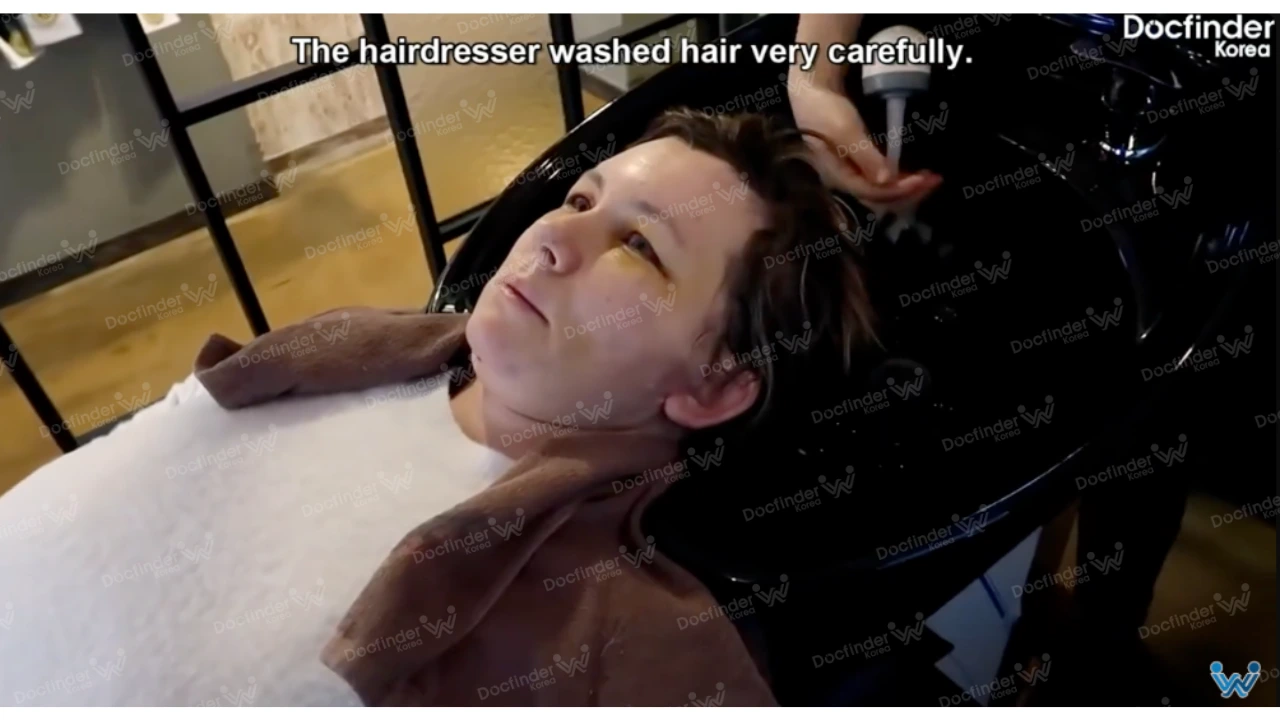
Her drains came out the next morning with the first dressing, and the team walked her through wound care: hydrogen peroxide on every suture line, no water near the incisions, and the compression garment starting on day three rather than immediately, because the swelling made it too painful before then.
She walked in short bursts with rests between. “We walk a bit, I sit on a bench, then we walk on,” she says. Cold air helped and stuffy shops did not. By that first evening the change was visible to her: “I feel really good right now, because it is cool outside and the swelling is going down in front of my eyes.” Her conclusion after three days was simple. “You have to walk more. It gets much easier straight away.” On day three she was cleared to wash her hair, and her coordinator booked the salon next door the night before so they could keep the afternoon for walking.
Day seven: the stitches come out
The moment most under eye blepharoplasty patients want to hear about is suture removal from the lower lid, and Irina asks her directly on camera. “Was it painful, taking the stitches out of the lower eyelid?”
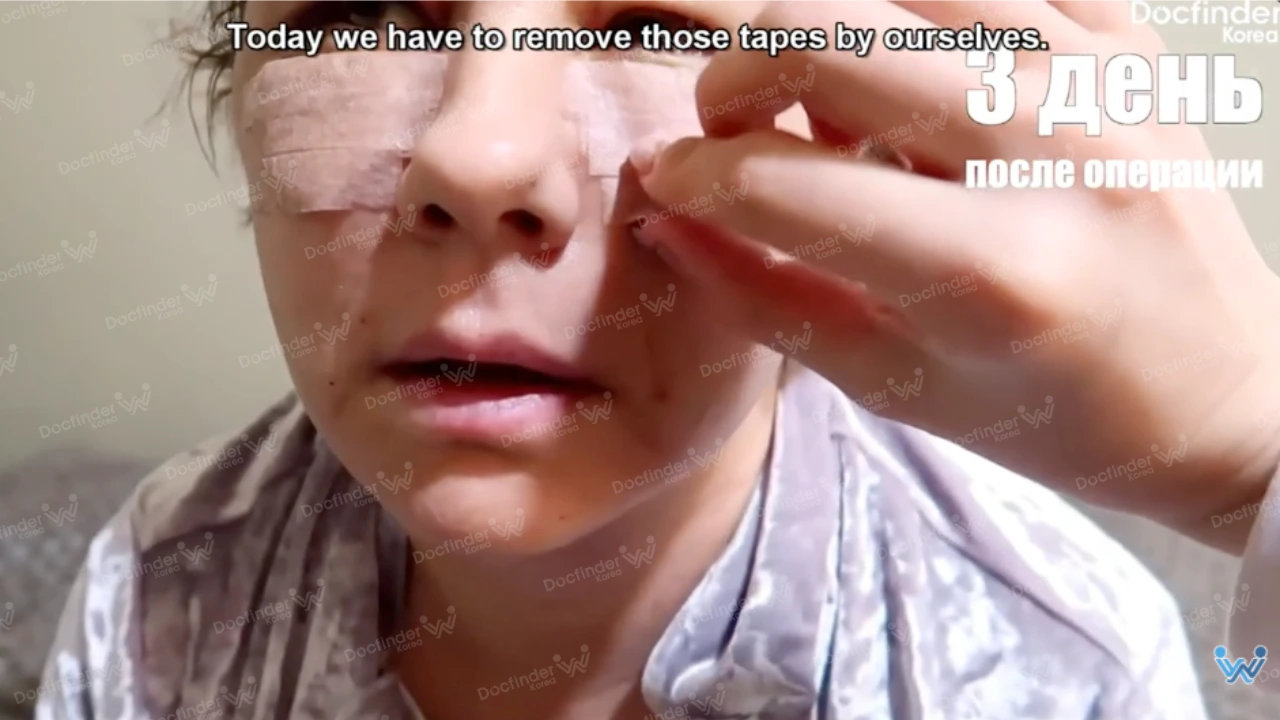
“No, it was not painful,” Elena answers. “Only one stitch caught a little, it must have grown in slightly. When she pulled it, even then it was not really painful, but the eye watered.”
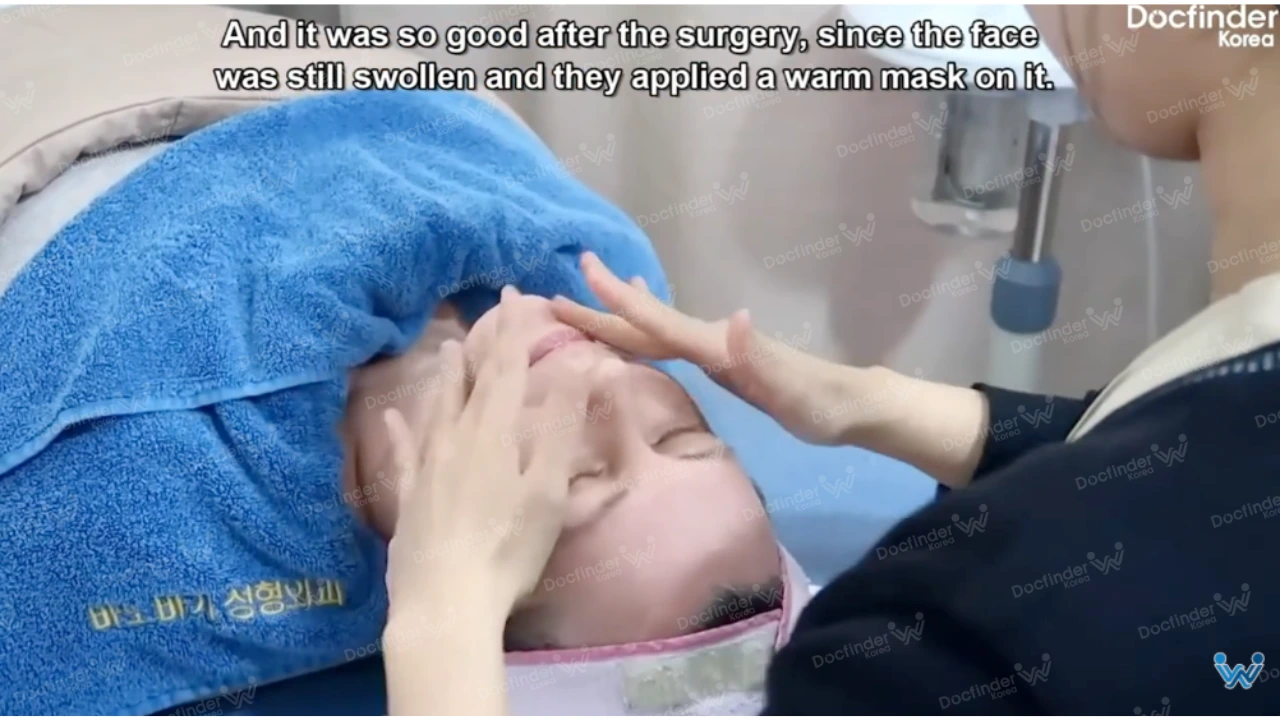
The clinic took out more that day than the schedule called for, because she was far enough ahead to bring it forward. “They said wow, you look very good,” Irina reports. “They said other patients look much worse at this stage.” Both credit the walking. Elena was also allowed to wash her face for the first time. “It felt like three tonnes of dirt came off. After I started using the serum, my face became really soft, elastic, and the bruises faded in front of my eyes.” That week also brought a hyperbaric oxygen session and a lymphatic massage with alternating warm and cold masks.
Day fourteen, and two months later
The last review was on day fourteen: final sutures out, an anti-aging laser session the same afternoon, and a flight home the next day. Two months later, filming the follow-up, Elena is direct about what the surgery did and did not do. Genetically deep nasolabial folds were not something lifting alone could erase, and she chose filler for those separately. But on the eyes she is unambiguous. “I went there to fix physical things,” she says. “And it turned out that not only am I fine physically now, nothing bothers me, my eye doesn't droop, everything is lifted. It also gave me so much moral strength.” Both are careful about expectations, though: Elena was told to wait six months for the true result, and Irina says her own face only really settled after a year.
Why Elena's Family Chose a Full-Care Agency, Not an App
Korea has excellent domestic booking platforms. Gangnam Unni and Babitalk are useful if you live in Seoul, read Korean and can walk into a clinic yourself. They are marketplaces: they connect you, take a booking, and their involvement ends at the door. That model breaks the moment the patient is a foreigner recovering in a hotel room. Elena's trip contained a dozen moments an app cannot cover: the coordinator at the clinic when she came out of theatre, the person who re-explained her medication and compression garment in Russian, the message that booked a hair wash, the interpreter on the shopping day. None of these are medical services, and all of them are the difference between recovering well and recovering anxiously.
Docfinderkorea's Full-Care Agency model rests on three commitments. Direct Surgery Monitoring means the agency tracks the operation and confirms that the surgeon you consented to is the surgeon who operates. In-Person Hospital Accompaniment means a coordinator attends consultations, admission and follow-up reviews with you, interpreting in your language. All-Inclusive Recovery Care means aftercare appointments, deswelling treatments, medication guidance and accommodation logistics arrive as one package, with a 24/7 Premium Concierge behind all three, so someone is reachable at three in the morning when you are unsure whether your eyelid looks normal.
Docfinderkorea is registered with Korea's Ministry of Health and Welfare as a medical tourism facilitator, a licensing requirement rather than a self-awarded badge, and the service costs the patient nothing, because the clinics pay the agency. The agency's job is to advocate for the patient inside the hospital rather than to sell to them.
How to Book Under Eye Blepharoplasty in Korea: Step-by-Step
- Free online consultation. Send photographs of your lower eyelids in natural light, straight on and at a slight angle, with your concerns and medical history. Korean specialists return an approach and price range at no charge.
- Planning your dates. The concierge blocks a surgery date, advises how long to stay and helps with accommodation near the clinic.
- Arrival and airport pickup. You are met at Incheon, with surgery usually on the second or third day to allow for jet lag and bloodwork.
- In-person consultation. Your coordinator attends and interprets, and the plan is finalised: transconjunctival or subciliary, repositioning or removal, canthopexy or laser.
- Surgery day with Direct Surgery Monitoring. You are accompanied to admission, the named surgeon is confirmed, and someone is there when you come out.
- The first week. Cold compresses, head elevated, short frequent walks and a wound check, with the concierge handling appointments and transport.
- Suture removal and departure. Sutures come out between day five and seven, a final review clears you to fly, and follow-up continues remotely by photograph.
Under Eye Blepharoplasty Korea Price 2026: What You Actually Pay
All figures below are guidance ranges for 2026 and should be confirmed in your own consultation. Conversions use roughly 1 USD to 1,419 KRW as of 13 August 2026; check the rate on the day you pay.
Under eye blepharoplasty on its own runs from about 4,000,000 to 7,000,000 Korean won in Seoul, roughly 2,800 to 5,000 US dollars. A dedicated under eye fat repositioning procedure, where the tear trough release is the main event, sits a little lower at about 3,100,000 to 5,000,000 won, or 2,200 to 3,500 dollars. Adding a canthopexy costs a further 1,700,000 to 4,000,000 won. Combining upper and lower eyelid surgery in one session, which saves both anaesthesia and recovery time, is generally quoted between 7,100,000 and 10,600,000 won, roughly 5,000 to 7,500 dollars.
In the United States the same surgery commonly totals 2,500 to 7,500 dollars once surgeon's fee, anaesthesia, facility charges and testing are added up, with metropolitan practices quoting 7,000 to 8,000 dollars for the lower lids alone, so Korea typically saves 40 to 60 percent. Thailand, Turkey and Mexico quote lower headline numbers, often 1,800 to 3,500 dollars, and the honest way to read those is that the cheapest tier of medical tourism buys the operation and very little else.
A Korean quote normally includes the surgeon's fee, anaesthesia, the facility, medication and follow-ups during your stay, but not flights, accommodation, optional deswelling treatments or any revision. Budget 1,200 to 2,500 dollars for travel and accommodation over a ten-day stay, and remember that agency coordination and accompaniment are free.
Under Eye Blepharoplasty Recovery Timeline: Week by Week
The under eye blepharoplasty recovery timeline is more predictable than most facial surgery, and the biggest variable is how disciplined you are in the first seventy-two hours.
Day 0 to day 2: the swelling peak
Expect tightness, a gritty sensation, watery or dry eyes and blurred vision from ointment, with swelling peaking in this window. Cold compresses go on in cycles, the head stays above the level of the chest at all times including in sleep, and gentle walking starts almost immediately. Elena's clinic pushed her to walk on the first day, and she credits that for how quickly the swelling turned around.
Day 3 to day 7: turning the corner
Bruising darkens before it fades, which alarms people who were not warned. Most patients are cleared to wash their hair and shower carefully around day three, sutures kept dry. Suture removal for subciliary cases falls between day five and seven; transconjunctival patients usually have nothing to remove. Elena's came out on day seven, ahead of schedule.
Week 2: back in public
By day 10 to 14 the bruising is gone or fully coverable with makeup, and this is when most patients feel comfortable being seen. Korean clinics fill this week with lymphatic massage, hyperbaric oxygen and low-level laser, and it is when the final review clears you to fly.
Week 3 to month 6
Residual firmness and slight asymmetry are normal and resolve as repositioned fat softens and integrates, while a subciliary scar goes through a pink phase before fading. Six months is the honest date for a final verdict, which is exactly what Elena was told.
The Seoul Recovery Lifestyle
Seoul is an unusually good city to heal in, and it is not an accident. There is a whole local culture around post-surgical swelling, from pumpkin juice, or hobakjeup, sold in every convenience store, to clinics that do nothing but lymphatic drainage and laser. Ice packs, gauze masks and gentle post-operative cosmetics come as standard in recovery guesthouses; Elena's came with two ice packs, a fabric mask for going outside without self-consciousness, and a voucher for the salon next door. Gangnam packs clinics, pharmacies, cafes and parks into a few walkable blocks, which suits a recovery whose prescription is short, frequent walks.
FAQ: Under Eye Blepharoplasty in Korea
Will under eye blepharoplasty get rid of my dark circles?
If the darkness is a shadow cast by a bulge and a hollow, yes, and often dramatically. If it is brown pigmentation or blue vessels visible through thin skin, surgery will not remove it and you should plan laser treatment alongside. Most people have a mixture, and a good consultation gives you a percentage rather than a promise.
How much does under eye blepharoplasty cost in Korea in 2026?
Roughly 4,000,000 to 7,000,000 won, or 2,800 to 5,000 dollars, for lower lid surgery on its own, with combined upper and lower work running to around 7,500 dollars.
Transconjunctival or subciliary, which should I choose?
Let your skin decide. If your lid skin is still taut and the complaint is purely puffiness, transconjunctival is almost always better. If you have real skin excess, subciliary allows redraping that a transconjunctival approach cannot.
How long do I need to stay in Korea?
Eight to ten days covers an isolated case, including surgery, suture removal and a final review. Combined cases need closer to two weeks; Elena, whose case was extensive, stayed fifteen days.
Are the results permanent?
Effectively, yes. Fat pads that have been removed do not return, and repositioned fat stays where it is placed and ages with the rest of the face. What continues is normal aging of the surrounding skin.
Will there be a visible scar?
A transconjunctival incision leaves no external scar, because it is inside the lid. A subciliary incision leaves a fine line under the lashes that is pink for a few weeks and then becomes very hard to see.
Does the stitch removal hurt?
Worth answering in a patient's own words. Elena, asked on camera immediately afterward, said it was not painful, that a single stitch caught slightly and made her eye water, and that was the whole of it.
Is it safe to travel to Korea for this alone?
Many patients do, and the accompaniment matters more than the companion. Almost every task Elena's daughter performed is one the Full-Care Agency performs as standard: solo patients are met at the airport, attended at every appointment, and can reach the 24/7 concierge at any hour.
Your Next Step
The question is not whether under eye blepharoplasty works. It is whether your particular shadow is the kind surgery fixes, and what that would cost you, and both are answerable in one free consultation from photographs.
Send yours through the free online consultation at https://docfinderkorea.com/quick-inquiry and Korean board-certified specialists will return an assessment and a price range. Docfinderkorea is a Full-Care Agency registered with Korea's Ministry of Health and Welfare, working only with KHIDI-registered hospitals and KSPRS board-certified surgeons, with a 24/7 Premium Concierge from your first message to your flight home. The service is free to you, because the clinics pay the agency, not the patient.
Related Articles
The Definitive 2026 Guide to Eyelid Surgery Cost in Korea: Expertise, Safety, and Total Value
Everything You Need to Know About Upper Blepharoplasty in Korea
Back