





Journal
Rhinoplasty Deviated Septum Korea 2026: Ricardo's Real Breathing Fix & Septorhinoplasty Guide
2026-06-25
Nose
Rhinoplasty Deviated Septum Korea 2026: Ricardo's Real Breathing Fix & Septorhinoplasty Guide
Summary
- Medical: A rhinoplasty deviated septum correction in Korea fixes the blocked airway and refines the nose in a single operation, typically at roughly 50–65% below comparable US prices.
- Technology: Seoul surgeons combine functional rhinoplasty for deviated septum with 3D-CT airway mapping and the patient's own septal cartilage, so breathing and aesthetics are corrected together.
- Care: Docfinderkorea's Full-Care Agency model — Direct Surgery Monitoring, In-Person Hospital Accompaniment, All-Inclusive Recovery Care, and a 24/7 Premium Concierge — guided Ricardo from his first online consultation to his Day 7 reveal at NANA Plastic Surgery Hospital.
Quick Facts: Rhinoplasty Deviated Septum in Korea (2026)
- Procedure: Septorhinoplasty — septoplasty (straightening the septum) plus rhinoplasty (reshaping the nose) in one surgery.
- Surgery duration: about 1.5–3 hours, depending on complexity.
- Anesthesia: general or deep sedation, with a full-time anesthesiologist on site.
- Method: open or closed approach; the deviated septal cartilage is often reused as a graft.
- Cast/splint removal: around day 5–7; most visible swelling settles within 2–3 weeks.
- Breathing improvement: often noticeable once internal swelling subsides, typically by weeks 3–6.
- Recommended stay in Korea: about 7–10 days for surgery, splint removal, and the first follow-up.
- Final refined result: continues to emerge over 6–12 months as deep swelling resolves.
Table of Contents
- Why Patients Choose Rhinoplasty Deviated Septum Surgery in Korea
- Rhinoplasty Deviated Septum: The Medical Edge in 2026
- Functional Rhinoplasty for Deviated Septum
- Septoplasty vs Rhinoplasty: What Is the Difference?
- Ricardo's Story: Finally Breathing Through Both Sides
- Why Ricardo Chose a Full-Care Agency, Not an App
- How to Book Rhinoplasty Deviated Septum Surgery in Korea: Step-by-Step
- Rhinoplasty Deviated Septum Korea Price 2026
- Deviated Septum Surgery Recovery: Week by Week
- The Seoul Recovery Lifestyle
- FAQ: Rhinoplasty Deviated Septum in Korea
- Your Next Step
- Related Articles
Why Patients Choose Rhinoplasty Deviated Septum Surgery in Korea
Korea has become one of the world's most trusted destinations for nose surgery, drawing tens of thousands of international patients to Seoul each year. The country's specialist density is unusually high: in the Gangnam district alone, board-certified surgeons perform functional and aesthetic nose procedures daily, and many have sub-specialized in the combined rhinoplasty deviated septum operation that treats breathing and shape at the same time. For someone who has spent years struggling to breathe through a crooked nose, that concentration of experience is the real draw.
It helps to be clear about what this surgery is and is not. A rhinoplasty deviated septum procedure is not simply a cosmetic nose job, and it is not a quick fix that ignores function. It is a structural correction: the surgeon straightens the wall between your nostrils so air flows freely, then reshapes the external nose so the result looks balanced and natural rather than obviously "done." The goal is a nose that works as well as it looks.
Who is an ideal candidate?
- You have a deviated septum that blocks airflow, causes snoring, or makes exercise and sleep harder.
- You are bothered by a crooked, asymmetric, or bumpy nose that often accompanies septal deviation.
- You want to solve both problems in one recovery rather than two separate surgeries.
- You are in good general health and have realistic, natural-looking goals.
That description fits Ricardo almost exactly. He traveled to Seoul to correct a deviated septum that had disrupted his sleep and workouts for years, while also hoping for a more balanced, natural nose. You can watch his journey in two parts:
Rhinoplasty Deviated Septum: The Medical Edge in 2026
What sets Seoul apart is not just volume but how precisely the combined operation is planned and executed. Several techniques define the modern approach to rhinoplasty deviated septum surgery.
3D-CT airway and structure mapping
Before surgery, many Seoul hospitals take a 3D-CT scan that shows exactly how the septum is deviated and where the airway is narrowed. This lets the surgeon plan the correction around your real anatomy instead of guesswork, which matters when the same cartilage that is blocking your breathing will be reshaped to improve the nose.
Using your own septal cartilage
In a well-planned rhinoplasty deviated septum operation, the deviated cartilage that is removed or trimmed during the septoplasty is not wasted. It is reshaped and reused as a structural graft to support the tip and bridge. Autologous (your own) cartilage integrates naturally, lowers the risk of rejection, and gives a sturdier, longer-lasting result than synthetic implants alone.
Natural, structure-first aesthetics
Korean rhinoplasty has shifted firmly toward natural results — refining the tip, straightening the bridge, and improving harmony with the rest of the face rather than creating an obvious, overdone nose. Because the airway is corrected at the same time, the outside can be refined without compromising the function inside.
A safety culture built on reassurance
Patients can relax knowing Korea's leading hospitals are built around accountability. Operating-room CCTV is increasingly standard, there is a strict "no ghost doctors" expectation so the surgeon you consult is the one who operates, and a full-time anesthesiologist manages your sedation. Docfinderkorea works only with KHIDI-registered hospitals and KSPRS board-certified plastic surgeons, so the credentials are verified before you ever board a flight. The result is a setting where you can focus on healing with confidence.
Functional Rhinoplasty for Deviated Septum
The phrase functional rhinoplasty for deviated septum describes exactly what Ricardo needed: surgery whose first priority is restoring normal breathing, with aesthetic refinement built on top of that foundation. A purely cosmetic nose job changes how the nose looks; functional rhinoplasty changes how it works, by straightening the septum, opening collapsed internal valves, and reinforcing weak cartilage so the airway stays open when you inhale.
In practice, functional rhinoplasty for deviated septum and aesthetic rhinoplasty are performed together in a single septorhinoplasty. The surgeon corrects the deviation, supports the structure with grafts, and then refines the external shape — so you recover once and walk away both breathing better and looking more balanced. For patients whose crooked nose is the visible symptom of an underlying septal problem, this combined functional approach is usually the most complete solution.
Septoplasty vs Rhinoplasty: What Is the Difference?
Understanding septoplasty vs rhinoplasty is the key to understanding this whole procedure. Septoplasty is the operation that corrects a deviated septum: the surgeon straightens the cartilage and bone that divide the two nasal passages so air can flow evenly. It is a functional surgery focused entirely on breathing, and on its own it does not change how the nose looks from the outside.
Rhinoplasty, by contrast, reshapes the visible nose — the bridge, tip, and overall profile. The septoplasty vs rhinoplasty distinction matters because a deviated septum often comes with a crooked external nose, and treating only one half leaves the other unresolved. That is why the combined septorhinoplasty exists: it merges both operations so the septum is straightened for breathing while the nose is reshaped for appearance, in one anesthesia and one recovery. When patients search for rhinoplasty deviated septum, this combined surgery is almost always what they actually need.
Ricardo's Story: Finally Breathing Through Both Sides
Ricardo is a city bus driver from Los Angeles who, by his own account, had "never had a surgery, ever." For years a deviated septum gave him "breathing issues at night, some breathing issues during exercise and some nuisances in day to day living." He was also self-conscious about the shape of his nose — as he jokes, he is Mexican but "my whole life people have been confusing me for Armenian" because of it.

He did not choose Korea at random. On an earlier trip, his wife had a rhinoplasty through Docfinderkorea and Nana Clinic, and as Ricardo puts it, "her results were great. Everlasting results. No issues whatsoever." So when he thought about his own nose, he asked Docfinderkorea what they could do. He had already gotten a price quote from a provider back home in California — and "ultimately Docfinderkorea was able to provide me way more for a better value than what my own hospital group is able to give me." He decided to "get this combo — get a rhinoplasty and get my deviated septum addressed," the classic rhinoplasty deviated septum combination.
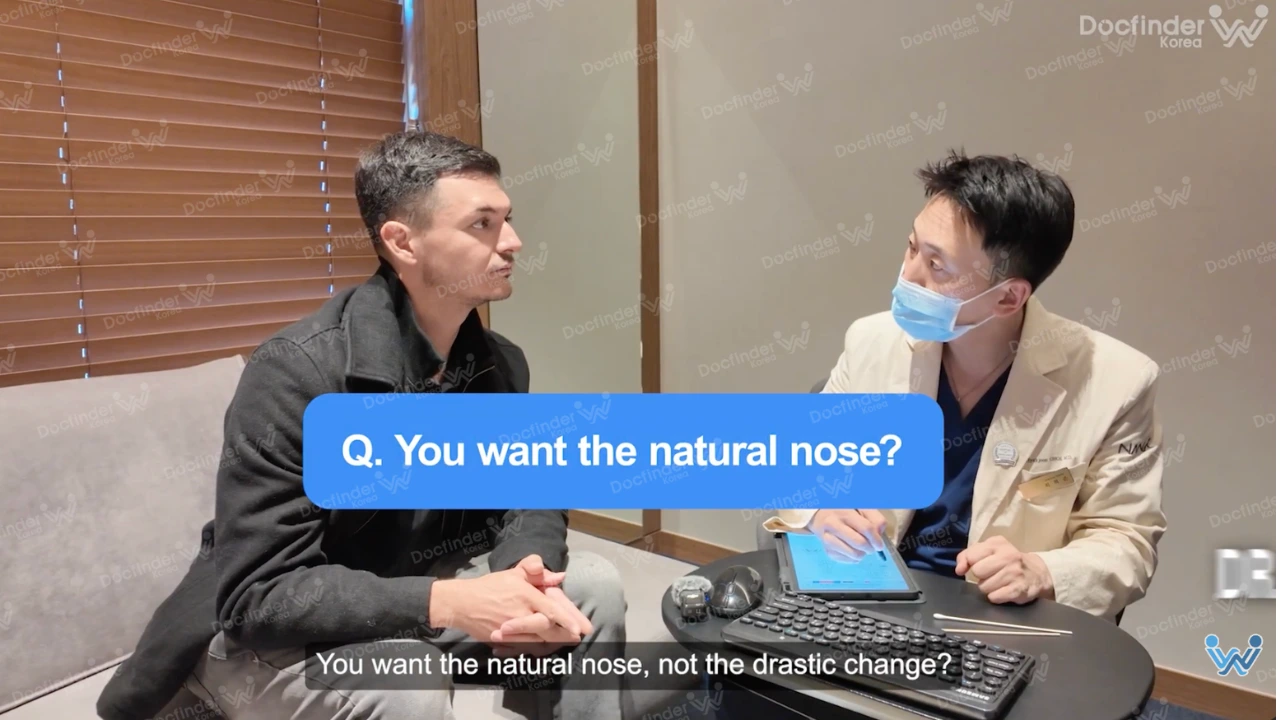
At the consultation, the plan was built around exactly what he wanted: "You want the natural nose, not the drastic change?" — "Yeah." Two specialists handled his case. The ENT surgeon took care of the function: "the membrane in the center is called septum, it is bent to one side, so I will remove the curved portions and straighten it," along with a turbinate reduction to open the airways. The plastic surgeon then refined the aesthetics — lowering a hump, lifting a long, droopy tip, correcting a bulbous tip and a slightly protruding columella — all without a silicone implant, because his nasal bridge was already high. It is a textbook example of functional rhinoplasty for deviated septum done in one operation.
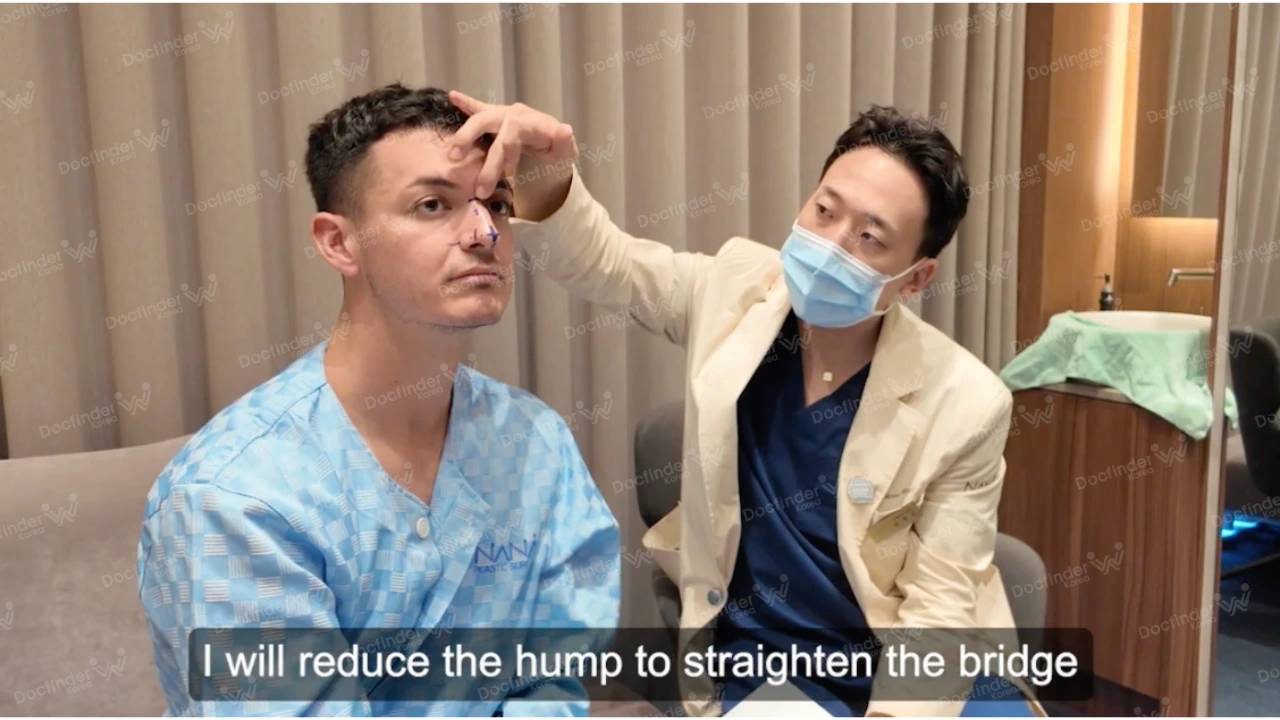
Ricardo was candid about the recovery, too. The toughest stretch was the first two days, mostly because of the packing: "I had two large cotton masses stuffed in my nose... after the cotton balls were out it got better from there." He rates the packing removal a memorable "10 out of 10... uncomfortable," comparing it to nose waxing — but says relief came right after.
Then came the milestone. On day 7 his stitches and the plastic inserts were removed and he saw his nose for the first time: "even though there's still swelling, I couldn't believe how my nose was looking... I was blown away with the results." He loved that the surgeon "didn't overdo it" and kept it "very masculine." Day 7 was also when he could finally breathe freely — "everything was open for the first time in a long time."

Why Ricardo Chose a Full-Care Agency, Not an App
Most people researching nose surgery in Korea first stumble onto domestic booking apps like Gangnam Unni or Babitalk. Those platforms are built for Korean-speaking locals on a book-and-go basis: you pick a clinic, you show up, and you are on your own for everything around the surgery. For an international patient who does not speak Korean and will be recovering far from home, that is a lot to manage alone — especially for a functional operation where follow-up matters.
Docfinderkorea is a full-care medical agency, not a marketplace, and it is registered with Korea's Ministry of Health and Welfare. It acts as the patient's advocate, and it works through three pillars:
- Direct Surgery Monitoring — confirming your chosen, board-certified surgeon is the one who actually performs your operation.
- In-Person Hospital Accompaniment — a coordinator physically with you at consultations and on surgery day, translating and advocating.
- All-Inclusive Recovery Care — managing aftercare, dressings, deswelling visits, and follow-ups so nothing slips through the cracks.
On top of that, a 24/7 Premium Concierge handles logistics from airport pickup to pharmacy runs. Crucially, this support comes at no extra cost to the patient — the clinics pay the agency — so a patient like Ricardo gets an advocate and a translator without inflating the price of the surgery itself.
How to Book Rhinoplasty Deviated Septum Surgery in Korea: Step-by-Step
- Free online consultation. Share your photos and concerns through Docfinderkorea's quick inquiry; get matched to KSPRS-certified surgeons suited to a combined septorhinoplasty.
- Airport pickup. Your 24/7 concierge meets you on arrival in Seoul and handles transfers.
- In-person consultation & 3D-CT. The surgeon examines your septum and airway, scans your structure, and finalizes the plan with you, with a coordinator translating.
- Surgery day with Direct Surgery Monitoring. Your verified surgeon performs the operation; the agency confirms it and supports you before and after.
- First week of recovery. All-Inclusive Recovery Care manages dressings, medication, and rest while swelling peaks and settles.
- Splint removal & deswelling. Around day 5–7 the cast comes off (Ricardo's Day 7 reveal), followed by deswelling care and a check-up.
- Fly home with follow-up. You return home with aftercare instructions and remote follow-up support as your nose continues to refine.
Rhinoplasty Deviated Septum Korea Price 2026
Pricing depends on complexity, the surgeon's seniority, the clinic tier, and whether the case needs extra grafting, so the figures below are guidance ranges rather than quotes. At the time of writing, the exchange rate is roughly 1 USD to 1,547 KRW (verify the current rate before budgeting, as it moves).
A standalone septoplasty — the functional correction of the deviated septum alone — typically runs from about $2,400 to $5,500 in Korea, with Seoul averaging around $3,950. Most patients searching for rhinoplasty deviated septum, however, want the combined septorhinoplasty that also reshapes the nose. That combined functional-and-aesthetic procedure generally ranges from about ₩6,000,000 to ₩14,000,000, which is roughly $4,550 to $10,600 at today's rate. Where you land in that range depends mainly on how much structural reshaping and grafting your nose requires.
For comparison, an equivalent combined procedure in the United States averages around $11,000 and often climbs higher once facility and anesthesia fees are added, so patients commonly save on the order of 50–65% by choosing Seoul — savings of roughly 64% are frequently cited for the functional portion alone. The value is not only the lower sticker price.
Ricardo experienced this value gap firsthand. After getting a quote from a provider in his home state of California, he chose Docfinderkorea because it could offer far more — a combined functional-and-aesthetic result — for better value than his hometown hospital group could match.
What the Korean price typically includes is the pre-operative consultation, the 3D-CT planning, the surgery itself, and standard post-operative follow-up. When you book through Docfinderkorea's Full-Care Agency, the coordination, in-person accompaniment, and recovery management are added at no extra cost because the clinics pay the agency. You should still budget separately for travel costs — flights and accommodation for roughly 7–10 days in Seoul — but those are usually modest next to the surgical savings.
Deviated Septum Surgery Recovery: Week by Week
The deviated septum surgery recovery timeline is one of the most common questions patients ask, and Ricardo's Part 2 video is an honest week-one record of it. Here is what to expect, with the concierge managing logistics at each stage.
Days 1–3: the hardest stretch
Expect congestion, swelling, and bruising around the nose and eyes, plus the strange sensation of breathing through your mouth while internal swelling and any packing are present. This is the uncomfortable part Ricardo is candid about; rest, head elevation, and cold care help, and your recovery team keeps medication and dressings on track.
Days 4–7: splint removal and the reveal
Around day 5 to 7 the external cast or splint is removed — Ricardo's emotional Day 7 reveal. The nose will still be swollen, but the new shape begins to show, and many patients feel a clear lift in morale at this milestone.
Weeks 2–3: back to daily life
Most visible swelling and bruising settle, and patients usually feel comfortable in public and back at desk work. Breathing often starts to improve noticeably as internal swelling subsides — the whole point of the deviated septum surgery recovery for a functional case.
Weeks 4–6: clearer breathing
Airflow continues to open up as the internal tissues calm down. Light exercise generally resumes around this window per your surgeon's guidance — the very activity that was difficult for Ricardo before surgery.
Months 3–12: the final refined nose
Deep tip swelling resolves slowly, and the definitive, refined result emerges over 6 to 12 months. Patience here is normal and expected; the nose keeps quietly improving long after you have returned to normal life.
Ricardo's own updates track this arc. By day 11 he could already see the swelling going down "day after day," and at three months he described a "night and day difference" — more confident and largely healed, with Nana Clinic telling him the sculpted result would keep refining for up to a year. The biggest surprise was functional: thanks to the turbinate reduction, his allergies eased dramatically. "This whole spring season I've only used an allergy pill three times, when I used to use antihistamine pills every day," he said. "I'm breathing a lot easier, breathing better at night." That combination of clearer airways and better sleep is exactly what a well-planned deviated septum surgery recovery is meant to deliver.
The Seoul Recovery Lifestyle
Recovering in Seoul is unusually comfortable. Korea has a whole supportive culture around healing — patients often sip pumpkin juice (hobakjeup), which is popular for helping reduce swelling, and deswelling clinics offer gentle treatments to speed the cosmetic recovery. Gangnam's convenience means pharmacies, cafes, and follow-up clinics are all within easy reach, and short, gentle walks are easy to fit in once you feel up to it. With Docfinderkorea's concierge handling transport, translation, and appointments, your only real job is to rest and heal while the city takes care of the logistics.
Ricardo's day-7 aftercare at Nana Clinic shows how far this support can go. Beyond the medical check, he was given LED light therapy ("red and blue rays" to reduce swelling), a gentle exfoliating facial, an ENT suction to clear his nose, and even a session in a hyperbaric oxygen chamber. "Whoa, where am I, at a spa?" he joked — adding that he was impressed Nana Clinic "even offers one."
FAQ: Rhinoplasty Deviated Septum in Korea
Will a rhinoplasty deviated septum surgery fix my breathing as well as my nose's appearance?
Yes — that is the entire point of the combined septorhinoplasty. The functional part straightens the septum to restore airflow, while the aesthetic part reshapes the nose, so you address both in one operation and one recovery.
What is the difference between septoplasty vs rhinoplasty?
Septoplasty is the functional surgery that straightens the deviated septum to improve breathing; rhinoplasty reshapes the visible nose. The combined procedure does both at once, which is what most deviated-septum patients ultimately want.
How much does it cost?
A standalone septoplasty in Korea runs roughly $2,400–$5,500, while a combined septorhinoplasty generally ranges about $4,550–$10,600, depending on complexity — typically 50–65% less than comparable US pricing. Treat these as guidance ranges, not quotes.
How long should I stay in Korea?
Plan for about 7–10 days, which covers the consultation, surgery, splint removal around day 5–7, and a first follow-up before you fly home.
Are the results permanent?
The structural correction of the septum is lasting, and using your own cartilage as a graft gives a durable result. The final refined shape settles over 6–12 months as deep swelling resolves.
Is it safe to use my own cartilage for grafting?
Yes. Autologous septal cartilage taken during the septoplasty integrates naturally and avoids the rejection risk of purely synthetic implants, which is why it is preferred in well-planned combined surgery.
Will there be visible scarring?
Incisions are placed inside the nostrils, or in a closed approach hidden internally; an open approach uses a tiny columellar incision that typically fades to near-invisible. Surgeons plan incisions specifically to minimize visible scarring.
Is it safe to travel abroad for this surgery?
Yes, with the right support. Ricardo had his procedure and recovery managed by Docfinderkorea's in-person accompaniment and 24/7 concierge, so he always had a translator and advocate on hand — he even joked afterward about going into modeling. The full-care model is what makes traveling for surgery feel safe and manageable, especially for a combined functional and aesthetic operation where follow-up matters.
Your Next Step
Ready to breathe better and love your nose? Start with a free online consultation at https://docfinderkorea.com/quick-inquiry. Docfinderkorea is a government-certified, Ministry of Health and Welfare-registered Full-Care Agency with a 24/7 Premium Concierge — and the coordination comes at no extra cost, because the clinics pay the agency. Like Ricardo, you can have your rhinoplasty deviated septum surgery and recovery guided from your first message to your final follow-up.
Related Articles
Rhinoplasty in Korea | Complete Seoul Nose Surgery Guide
How Much is the Cost of Getting Rhinoplasty in Korea?
What Are the Different Types of Rhinoplasty Procedures in Korea?
Back