





Journal
The Definitive 2026 Guide to Eyelid Surgery Cost in Korea: Expertise, Safety, and Total Value
2026-02-20
Eyes
The Definitive 2026 Guide to Eyelid Surgery Cost in Korea: Expertise, Safety, and Total Value
Summary
- Medical — A clear, transparent look at eyelid surgery cost in Korea in 2026, covering double eyelid surgery, ptosis correction, upper and lower blepharoplasty, under-eye fat repositioning, and canthoplasty, with real prices and what each one actually buys you.
- Technology — The 2026 "Bespoke Eye": multi-point natural adhesion, transconjunctival (no-scar) under-eye fat repositioning, and AI-driven 3D simulation so you see the plan before a single incision.
- Care — Docfinderkorea's full-care model: 1-on-1 medical translation, airport pickup, monitored recovery, and tax-refund support, all at no extra cost because the clinics pay the agency, not you.
Quick Facts: Eyelid Surgery in Korea (2026)
- Typical price range: roughly $1,500 to $5,500 USD depending on the procedure, often 30 to 50 percent less than the United States or Australia.
- Surgery time: about 30 to 90 minutes for most eyelid procedures, usually under local anesthesia with light sedation.
- Stitch removal: around day 5 to 7 for incisional methods.
- Back to social life: most patients feel comfortable in public within 1 to 2 weeks; final settling at 3 to 6 months.
- Exchange rate used here: about 1 USD to 1,540 KRW (June 2026, verify on the day you pay).
Table of Contents
- Why Korea Leads the World in Eye Aesthetics
- Breaking Down the Numbers: Eyelid Surgery Cost in Korea 2026
- Understanding the Anatomy: Why Experience Is Key
- Rowena's Story: "I Just Don't Want to Look Sad Anymore"
- Vee's Story: "People Said I Looked Tired"
- The Docfinderkorea Advantage: Why Our Service Is Free
- The Emotional Journey: What to Expect During Recovery
- Comparing Global Costs: Why Korea Is the Rational Choice
- 2026 FAQ: Common Questions from International Patients
- Final Checklist for Your Trip
- Conclusion: Your Vision, Our Mission
- Related Articles
1. Why Korea Leads the World in Eye Aesthetics
They say the eyes are the windows to the soul, but in modern aesthetics they are also the first place that tells our story, reflecting our energy, our youth, and sometimes our fatigue. As we move through 2026, South Korea remains the global capital for eyelid surgery (blepharoplasty), blending surgical mastery with an artistic touch that is hard to find anywhere else.
If you are considering traveling to Seoul, the question of cost is likely at the top of your mind. As we often tell our patients at Docfinderkorea, the price tag is only one part of the equation. Understanding the value of the expertise, the safety, and the seamless support you receive is what truly makes a journey successful.
In 2026, the trend has shifted entirely toward natural harmony, what we call the Bespoke Eye. Patients no longer want a crease that looks done or overly dramatic. They want a result so seamless it looks as if they were born with it. South Korea performs more eyelid surgeries per capita than any other nation, and that volume has produced surgeons who focus exclusively on the eye area for decades. This micro-specialization is a primary reason the eyelid surgery cost in Korea represents such high value. You are not just paying for a procedure; you are paying for thousands of hours of perfected technique and a deep understanding of both Asian and international facial structures.
2. Breaking Down the Numbers: Eyelid Surgery Cost in Korea 2026
One of the most common anxieties for international patients is the so-called foreigner markup. At Docfinderkorea we act as your advocate so that you pay the same fair price as a local resident. Here is how the numbers tend to look in 2026, written out so you can see exactly what each procedure involves.
Upper eyelid procedures
A non-incisional double eyelid, created through natural adhesion, generally runs from about $1,500 to $3,000. It suits younger patients with thin skin and minimal fat, and it offers a quick three-to-five-day recovery. A full incisional double eyelid, ideal for thicker skin or when meaningful fat removal is needed, generally costs from about $2,800 to $5,200 and gives a permanent, defined crease. Ptosis correction, which repairs the levator muscle that lifts the eyelid, typically ranges from about $2,500 to $5,500; this is the procedure for sleepy or heavy eyes where the lid simply does not open as it should.
Lower eyelid and under-eye
Lower blepharoplasty, focused on removing or repositioning the fat that creates eye bags, generally costs from about $2,800 to $5,000. Under-eye fat repositioning, the Korean signature technique, usually falls between about $2,200 and $3,500 for a standard case; instead of discarding the bag, the surgeon slides that fat down into the hollow tear trough to create a smooth slope from lid to cheek. When patients combine upper and lower work into a total eye rejuvenation, the package commonly lands in the $5,000 to $7,500 range.
Shape-enhancing surgery (canthoplasty)
Epicanthoplasty and lateral canthoplasty, which adjust the horizontal length or the tilt of the eye for a wider, more open look, generally cost from about $1,200 to $2,800 per area. At roughly 1,540 won to the dollar, a $3,000 procedure is in the region of 4.6 million KRW, but always confirm the exchange rate on the day you pay.
3. Understanding the Anatomy: Why Experience Is Key
Eyelid surgery may seem simple, but it is a game of millimeters. A surgeon has to navigate a complex landscape of muscle, fat pads, and delicate skin. In many Western countries the operation is performed by general plastic surgeons. In Korea the field has produced oculoplastic specialists who dedicate their entire careers to the orbital area.
The no-trace evolution
In 2026 the natural adhesion method has reached a new peak. Instead of a single thread, surgeons use multi-point anchoring systems, often seven to ten points, that mimic how a natural double eyelid forms. This significantly reduces the chance of the crease unraveling over time, a common issue with older techniques. For the under-eye, most repositioning is now done transconjunctivally, through the inside of the lower lid, so there is no external scar and the natural shape of the eye is preserved.
3D virtual simulation
Before a single incision is made, top Seoul clinics now use AI-driven 3D imaging so you can see a digital projection of your potential result. This bridges the gap between your expectations and the final outcome and helps you feel confident from day one.
4. Rowena's Story: "I Just Don't Want to Look Sad Anymore"
Numbers tell you what a surgery costs. A real patient tells you what it means. Rowena, who is 50 and traveled from Sydney, Australia, documented her whole journey with Docfinderkorea, and her experience shows exactly how the eye-area decisions in this guide play out in real life.
"Hello, I'm Rowena, I'm from Sydney, Australia, I'm 50 years old," she says at the start of her trip. Her reason for coming was not vanity so much as expression. "Generally a lot of people just think I look sad all the time and I'm just no emotion, and they just think, are you OK? And I'm like, yeah," she explains. "So I think more of a just a general feeling that I don't look sad to everyone would be nice."

At her consultation, the conversation turned to her under-eyes, and her surgeons took the conservative path this guide describes rather than aggressive cutting. As Rowena recounts it: "The doctor that was talking about doing under eyes suggested not to do much surgery as to cut in, so that my eyes don't flip out. So we'll just be a little more conservative and just go with fat grafting to fill the area." That choice, filling the hollow instead of removing tissue, is precisely the modern Korean philosophy of repositioning and adding volume rather than hollowing the eye out.
What stayed with our coordinators was how grounded her expectations were. "I want the age reset to how I feel, not to what I look like," she said the night before surgery. "Well, I'm not expecting it to change my life, but I am expecting to feel better about myself in my life. I don't expect a new face to be a new life; it's still going to be me, I just think it will help me get on with my life with less worries about how people see me. People always think I'm sad; hopefully they won't see that anymore." Rowena had her procedures at a partner clinic in Seoul with a Docfinderkorea coordinator beside her on surgery day.
Watch Rowena's full journey (Docfinderkorea):
5. Vee's Story: "People Said I Looked Tired"
Where Rowena's concern was looking sad, Vee's was looking tired, the single most common reason patients in their forties and fifties come to us for eye surgery. "I'm here in Korea because I wanted to refresh my face," she says. "My main concerns are my nose and my eyes."
Her under-eye change had a very specific cause that many patients will recognize. "Over the last two, three years I've lost a lot of weight, and my skin underneath my eyes was sagging more, if that makes sense, because I don't have the fat there anymore," she explains. On the upper lid, the story was about elasticity: "I always had hooded eyes, but about six months ago I had a really bad reaction to something in my skin and my skin didn't snap back, so it's now quite loose." She had also begun to notice, in her words, that her eyes were "starting to droop a little."
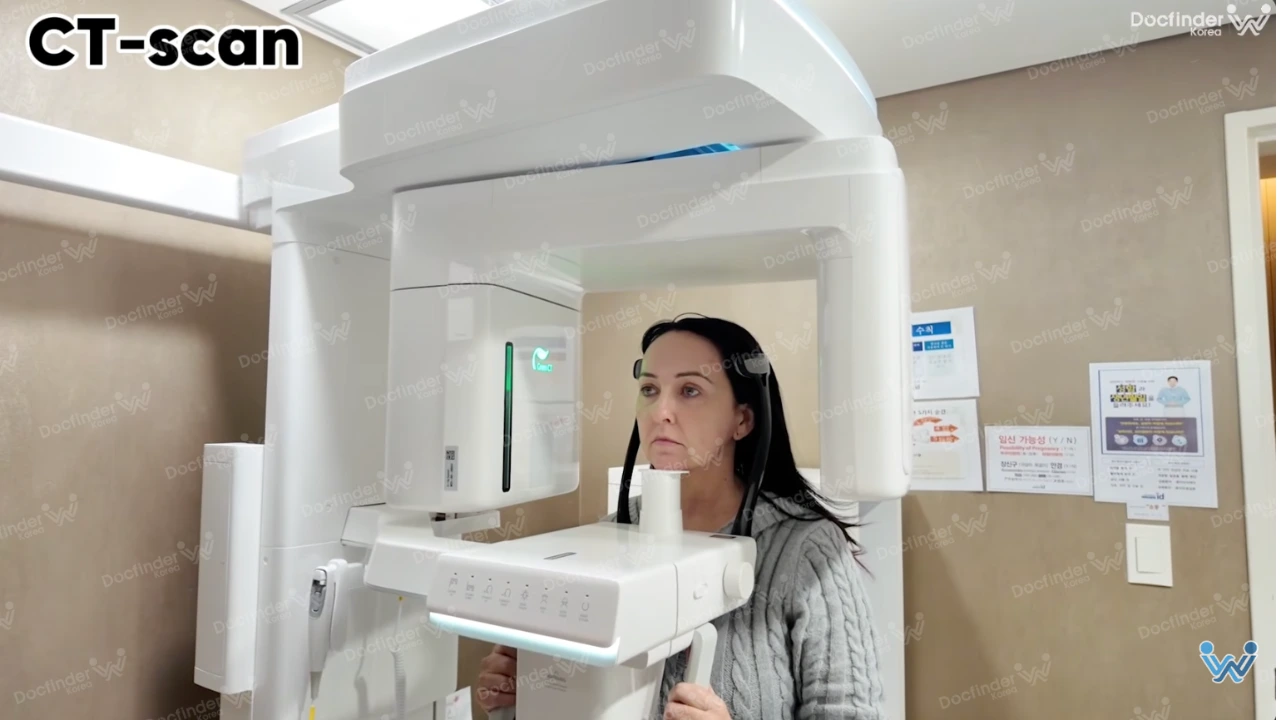
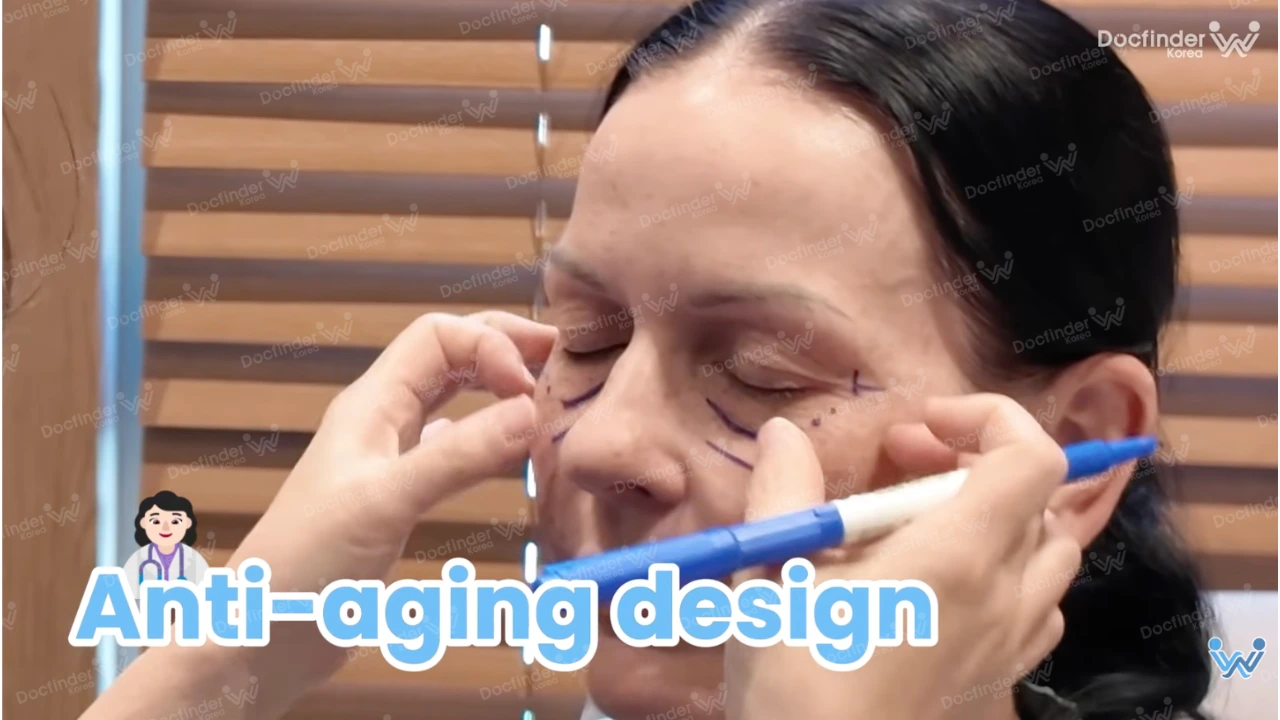
Her consultation is a textbook example of why an experienced surgeon matters. Rather than simply cutting eyelid skin, the surgeon explained that the heaviness of her brow was pushing down on the lids, and demonstrated how lifting it smoothed everything above the eye. The plan combined an upper blepharoplasty to neaten the loose upper lid, fat grafting under the eyes to refill the area she had lost, and a forehead and brow lift to address the root cause of the hooding. "The surgeries that I was planning to do mainly were my nose and my eyes, do a bit of a lift on my forehead, a lift in my eyebrows, a bit of fat grafting underneath my eyes," she summarizes.

She kept her sense of humor throughout. "My son always says to me, oh you got such a big forehead, I can see the stars," she laughs. "Kids are real, so nasty." Her case shows how, in skilled hands, the eye area is treated as one connected unit, brow, upper lid, and under-eye together, rather than a single isolated cut.
Watch Vee's full anti-aging and eye journey (Docfinderkorea):
6. The Docfinderkorea Advantage: Why Our Service Is Free
Navigating the competitive medical landscape of Gangnam can be daunting. Docfinderkorea was established as a government-registered agency to solve exactly the problems Rowena and Vee could have faced alone: language, logistics, and knowing which surgeon to trust.
How is it free? We operate as the official international support arm for Korea's top-tier hospitals. The hospitals compensate us because we handle the logistics, translation, transport, and post-op care, which lets their surgeons focus entirely on operating. You pay the hospital directly, at the same price a local pays.
What free includes at Docfinderkorea: 1-on-1 medical translation by coordinators trained in surgical terminology, so your wishes are communicated precisely; airport pickup so your journey starts without stress; prescription and pharmacy support, including explaining your dosage; monitored recovery, so a concern is only a phone call away; and tax-refund assistance to help you claim your 10 percent VAT refund at the airport.
7. The Emotional Journey: What to Expect During Recovery
One thing generic articles miss is the human side of recovery. Your time in Seoul can be an emotional rollercoaster, and being prepared is half the battle.
In the first one to three days, swelling and bruising peak, and it is completely normal to feel a flash of regret or anxiety in the mirror. This is the stage Rowena braced for when she said she was "ready to get hurt again" in pursuit of feeling better. At Docfinderkorea our coordinators are on hand with ice packs, reassurance, and professional monitoring.
Around day seven the stitches usually come out, pressure and swelling drop noticeably, and excitement tends to kick in. Through the first one to three months your eyes may look slightly asymmetrical or sit a touch high; remember that internal tissue heals more slowly than skin. By about month six the scar line, if any, becomes nearly invisible and the crease settles into its natural position. Korea's recovery culture helps here too, with deswelling LED and oxygen therapies and light, low-sodium meals that partner clinics build into the stay.
8. Comparing Global Costs: Why Korea Is the Rational Choice
Put the 2026 global averages for blepharoplasty side by side and Korea's value becomes clear. In the United States the procedure commonly runs from about $5,000 to $10,000, often before facility fees. Across the United Kingdom and Europe it tends to sit between roughly 4,500 and 8,000 euros. In South Korea the same work generally falls between about $2,500 and $5,500, and that figure already includes the premium concierge care described above. Even after factoring in flights and accommodation, the total investment in Korea is frequently lower than in Western countries, while the surgical outcome and the overall experience are often significantly better.
9. 2026 FAQ: Common Questions from International Patients
Can I get eyelid surgery if I have dry eye syndrome?
Yes, but a thorough consultation is required. Korean surgeons are careful not to over-resect skin, in order to preserve eye moisture.
Can I get eyelid surgery if I have had LASIK?
Yes, though it is generally recommended to wait at least three to six months after vision-correction surgery. Always tell your coordinator your full medical history.
How do I handle the VAT tax?
As an international visitor you are eligible for a 10 percent VAT refund, and Docfinderkorea makes sure your paperwork is ready to claim it at the airport.
Is the result permanent?
Incisional methods are permanent. Non-incisional methods are very durable in 2026 but may naturally loosen over ten to fifteen years as the skin ages. Under-eye fat repositioning typically holds for ten to fifteen years.
10. Final Checklist for Your Trip
- Passport with at least six months of validity.
- Button-down shirts, so you do not have to pull clothing over your head and face.
- Accommodation in the Gangnam or Sinsa area for easy clinic access; we can share a list of recommended hotels.
- Sunglasses to protect your eyes from UV and wind during the first week.
11. Conclusion: Your Vision, Our Mission
The eyelid surgery cost in Korea in 2026 reflects a medical system that has reached its peak, a culture that treats plastic surgery as a delicate art form. As Rowena and Vee both found, the right plan is rarely the most aggressive one; it is the one that fits your face and your reasons for being there. By choosing Docfinderkorea, you ensure that your journey, from the first message to the final check-up, is handled with professionalism, empathy, and integrity. The eyes you have always wanted are within reach, and we are here to help you get there. To start, we can find the clinics best suited to your specific eye shape for a free quote at https://docfinderkorea.com/quick-inquiry.
Related Articles
Under Eye Blepharoplasty in Korea 2026: The Ultimate Guide
Brow Lift Endoscopic in Korea 2026: Ella's Real Story
Plastic Surgery for Eyes in Korea 2026: Guide to Natural Results
Making Asian Eyes Bigger: A Guide to Safe Eye Surgery in Korea 2026
Back